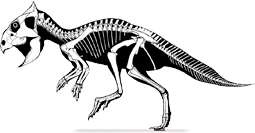
LEPTOCERATOPS
a small leptoceratopsid ceratopsian dinosaur from the Late Cretaceous of Canada.
Pronunciation: LEP-to-SEH-ruh-tops
Meaning: Small horn-face
Author/s: Barnum Brown (
1914)
Synonyms: None known
First Discovery: Alberta, Canada
Acta Ordinal: #115
Leptoceratops gracilis
Although
Leptoceratops is related to the horn-faced colossus that is
Triceratops and may have shared its time and place, it was tiny by comparison. However, size is no guarantee of strength. It's no guarantee of having an entire group of dinosaurs named in your honour either, and despite being less than two meters long and only about the weight of a wolf,
Leptoceratops anchors Leptoceratopsidae: a family of small, possibly bipedal, "horn-faced" (ceratopsian) herbivores who are surprisingly lacking in the face horn department, but are united by the presence of incredibly deep, robust jaws and huge, bulbous teeth.
(Slender, Small Horn Face)Etymology
Leptoceratops is derived from the Greek "leptos" (small), "ceras" (horn) and "ops" (face).
The
species epithet,
gracilis, means "slender" in Latin.
Discovery
The first remains of
Leptoceratops were discovered in the Scollard Formation, 3 miles above Tolman Ferry, Red Deer Valley, Edmonton, Alberta, Canada, by Barnum Brown in 1910. The
holotype (AMNH 5205) consists of parts of a skull and jaws, a series of articulated tail vertebrae, a complete forelimb and parts of both hind limbs.
More, and more complete, specimens were discovered in the same area by C.M. Sternberg in 1947 and in the Bighorn Basin of northern Wyoming by JH Ostrom in 1978. Three multi-specimen bonebeds have been reported from the Hell Creek Formation of Montana, which are hypothesized to represent communal nesting burrows.
Estimations
Timeline:
Era: Mesozoic
Epoch: Late Cretaceous
Stage: Maastrichtian
Age range: 71-66 mya
Stats:
Est. max. length: 1.8 meters
Est. max. hip height: 0.6 meters
Est. max. weight: 45 Kg
Diet: Herbivore
Second Species?
A specimen collected in the St. Mary River Formation of Buffalo Lake, Montana, by Barnum Brown in 1916 was assigned as a second species of
Leptoceratops:
Leptoceratops cerorhynchos, by Brown and and Erich Maren Schlaikjer in 1942. However, later discoveries showed that this material belonged to a hitherto unknown genus that Sternberg named
Montanoceratops in 1951.
References
• Brown B (1914) "
Leptoceratops, a new genus of Ceratopsia from the Edmonton Cretaceous of Alberta".
Bulletin of the American Museum of Natural History, 33(36): 567-580.
• Nopcsa FB (1923) "Die Familien der Reptilien" [The families of reptiles].
The Journal of Geology, 31(8). [coins Leptoceratopsidae.]
• Brown B and Schlaikjer EM (April 30, 1942) "
The skeleton of Leptoceratops with the description of a new species".
American Museum novitates: 1169.
• Sternberg CM (1951) "Complete skeleton of
Leptoceratops gracilis Brown from the Upper Edmonton Member on Red Deer River, Alberta".
National Museum of Canada Bulletin, 123: 225-255.
• Ostrom JH (1978) "
Leptoceratops gracilis from the "Lance" Formation of Wyoming". Journal of Paleontology. SEPM Society for Sedimentary Geology. 52 (3): 697–704
Dodson P (1998) "
The Horned Dinosaurs: A Natural History".
• You H and Dodson P (2004) "Chapter 22. Basal Ceratopsia". Page 478–493 in Weishampel, Dodson and Osmólska (eds.) "
The Dinosauria: Second Edition".
• Senter P (2007) "Analysis of forelimb function in basal ceratopsians".
Journal of Zoology, 273(3): 305–314. DOI: 10.1111/j.1469-7998.2007.00329.x
• Ott CJ (2006) "Cranial anatomy and biogeography of the first
Leptoceratops gracilis (Dinosauria: Ornithischia) specimens from the Hell Creek Formation,
southeast Montana". Page 213–234 in Carpenter (ed.) "
Horns and Beaks: Ceratopsian and Ornithopod Dinosaurs".
• Russell DA (2011) "A skeletal reconstruction of
Leptoceratops gracilis from the upper Edmonton Formation (Cretaceous) of Alberta".
Canadian Journal of Earth Sciences, 7(1): 181-184. DOI: 10.1139/e70-014.
• Dingus L (2012)
"Barnum Brown: the man who discovered Tyrannosaurus rex".
• Varriale F (2016) "Dental microwear reveals mammal-like chewing in the neoceratopsian dinosaur
Leptoceratops gracilis".
PeerJ, 4(7): e2132. DOI: 10.7717/peerj.2132.
• Fowler DW, Wilson JP, Freedman Fowler EA and Horner JR (2022) "
The Horned Dinosaur Leptoceratops (Ornithischia: Neoceratopsia) Raised its Young in Communal Nesting Burrows: Evidence from Three New Bonebeds in the Hell Creek Formation (Maastrichtian, Late Cretaceous), Montana".
Dickinson Museum Center, Cretaceous and Beyond, Abstracts.
Time stands still for no man, and research is ongoing. If you spot an error, or want to expand, edit or add a dinosaur, please use
this form. Go
here to contribute to our FAQ.
All dinos are GM free, and no herbivores were eaten during site construction!
To cite this page:
Atkinson, L.
"
LEPTOCERATOPS :: from DinoChecker's dinosaur archive".
‹
http://www.dinochecker.com/dinosaurs/LEPTOCERATOPS›. Web access: 18th Oct 2026.