Ornithischia
Cerapoda
Marginocephalia
Ceratopsia
Neoceratopsia
Coronosauria
Leptoceratopsidae
Anchor:
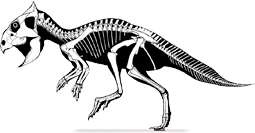
Leptoceratops gracilis
Pronunciation: LEP-to-SER-a-tops-uh-day
Author: Nopcsa
Year: 1923
Meaning: Small horn faces (see etymology)
Locomotion: Quadrupedal and bipedal (two and four legs)
Synonyms: None known
[Makovicky, 2001]Definition
The most inclusive clade containing Leptoceratops gracilis but not Triceratops horridus.
About
Despite the name, members of Leptoceratopsidae (small horn faces) didn't have horned faces. They were small, though, being only a fraction of the size of the similarly four-legged ceratopsids (horn faces) with whom they shared the Santonian to Maastrichtian periods of the Late Cretaceous. But thanks to a few nifty features, they managed to avoid being eaten into starvation by their much larger cousins.
Though mostly around two meters in length and with modest neck frills, leptoceratopsids had massive, robust lower jaws with huge, bulbous teeth. Ceratopsids, by comparison, had shallow jaws with slender double-rooted teeth. Different dentition and jaw structure suggest these two families favoured different vegetation, which allowed them to flourish side by side almost exclusively in Asia and North America. An as-yet-unnamed form, whose remains were discovered whilst sieving Swedish Åsen and Ullstorp sediment, may represent the first (and only) leptoceratopsid from Europe.
Click here to search Dinochecker for leptoceratopsids.
Etymology
Leptoceratopsidae is derived from the Greek "leptos" (small), "ceras" (horn), "ops" (face) and "-idae" (family), named for their small size and close relationship to Leptoceratops.
Relationships
References
• Nopcsa FB (1923) "Die Familien der Reptilien" [The families of reptiles]. The Journal of Geology, 31(8).
• Brown B (1914) "Leptoceratops, a new genus of Ceratopsia from the Edmonton Cretaceous of Alberta". Bulletin of the American Museum of Natural History, 33(36): 567-580.
• Lindgren J, Currie PJ, Siverson M, Rees J, Cederström P and Lindgren F (2007) "The First Neoceratopsian Dinosaur Remains From Europe". Palaeontology, 50(4): 929–937.