
THERIZINOSAURUS
a plant-eating therizinosaurid theropod dinosaur from the Late Cretaceous of Mongolia.
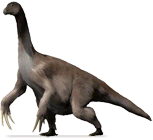
Pronunciation: THER-ih-ZEE-no-SOR-us
Meaning: Reaping or Scythe lizard
Author/s: Maleev (
1954)
Synonyms: None known
First Discovery: Ömnögovi, Mongolia
Acta Ordinal: #202
Therizinosaurus cheloniformis
(Turtle-like scythe lizard)Etymology
Threrizinosaurus is derived from the Greek "therizo" meaning "to reap" or "to cut off" (with a scythe) referring to its scythe-like claws) and "sauros" (lizard).
The
species epithet,
cheloniformis, means turtle-form (or turtle like) because of Evgeny Aleksandrovich Maleyev's 1954 assumption that it was some kind of gigantic turtle-like reptile.
Discovery
The first fossils of
Therizinosaurus were discovered at Quarry V in the Nemegt Formation, Ömnögovi aimag (south Gobi province), Mongolia, by the USSR Academy of Science's Mongolian Paleontological Expedition in 1918.
The
holotype (PIN 551/483) is a set of three hand claws, fragments of metacarpals, and fragments of ribs that turned out to belong to a sauropodomorph.
In 1976, Barsbold assigned several specimens from Khermin Tzav to
Therizinosaurus: IGM 100/15 (two shoulder blades, two partial arms, and fragmentary
ribs from the back and belly), and IGM 100/16 and IGM 100/17 (two hand claws). In 1982, Perle added a hindlimb (MPC-D 100/45), found in the same beds by the Joint Soviet-Mongolian Paleontological Expedition in 1973.
Estimations
Timeline:
Era: Mesozoic
Epoch: Late Cretaceous
Stage: Maastrichtian
Age range: 71-68 mya
Stats:
Est. max. length: 9.5 meters
Est. max. hip height: ?
Est. max. weight: 5 tons
Diet: Herbivore
Therizinosaurus
cheloniformis
References
• Maleyev EA (1954) "Noviy chyeryepoobrazniy
yashschyer Mongolii" [
A new turtle-like reptile from Mongolia].
 Priroda, 1954: 106-108. (English translation by Jaime A. Headden).
• Rozhdestvensky AK (1970) "On the gigantic unguals of some enigmatic Mesozoic reptiles".
Paleontologicheskii Zhurnal: 131–141.
• Barsbold R (1976) "New data on
Therizinosaurus (Therizinosauridae, Theropoda)".
Transactions, Joint Soviet–Mongolian Paleontological Expedition, 3: 76–92.
• Perle A (1982) "
A hindlimb of Therizinosaurus sp. from the Upper Cretaceous of Mongolia".
Problems on the Geology of Mongolia, 5: 94-98. (English translation by W. Robert Welsh.)
• Barsbold R and Maryanska T (1990) "Saurischia Sedis Mutabilis: Segnosauria". Page 408-415 in Weishampel, Dodson and Osmólska (eds.) "
The Dinosauria: First Edition".
• Russell DA (1997) "Therizinosauria". Page 729-730 in Currie and Padian (eds.) "
Encyclopedia of dinosaurs".
• Senter P and James RH (2010) "Hip heights of the gigantic theropod dinosaurs
Deinocheirus mirificus and
Therizinosaurus cheloniformis, and implications for museum mounting and paleoecology".
Bulletin of Gunma Museum of Natural History, 14: 1-10.
• Paul GS (2010) "
The Princeton Field Guide to Dinosaurs".
• Zanno LE (2010) "
A taxonomic and phylogenetic re-evaluation of Therizinosauria (Dinosauria: Maniraptora)".
Journal of Systematic Palaeontology, 8(4): 503-543. DOI: 10.1080/14772019.2010.488045.
• Lautenschlager S, Rayfield EJ, Altangerel P, Zanno LE and Witmer LM (2012) The Endocranial Anatomy of Therizinosauria and Its Implications for Sensory and Cognitive Function.
PLoS ONE, 7(12): e52289. DOI: 10.1371/journal.pone.0052289.
• Lautenschlager S (2014) "
Morphological and functional diversity in therizinosaur claws and the implications for theropod claw evolution".
Proceedings of the Royal Soccirty B, 281(1785): 20140497.
DOI: 10.1098/rspb.2014.0497.
• Molina-Pérez R and Larramendi A (2019) "
The Encyclopedia of Dinosaurs: The Theropods" [Dinosaur Facts and Figures: The Theropods and other Dinosauriformes].
• Qin Z, Liao CC, Benton MJ and Rayfield EJ (2023) "Functional space analyses reveal the function and evolution of the most bizarre theropod manual unguals".
Communications Biology, 6(181). DOI: 10.1038/s42003-023-04552-4.
Time stands still for no man, and research is ongoing. If you spot an error, or want to expand, edit or add a dinosaur, please use
this form. Go
here to contribute to our FAQ.
All dinos are GM free, and no herbivores were eaten during site construction!
To cite this page:
Atkinson, L.
"
THERIZINOSAURUS :: from DinoChecker's dinosaur archive".
‹
http://www.dinochecker.com/dinosaurs/THERIZINOSAURUS›. Web access: 22nd Oct 2026.









