









Pronunciation: nan-kan-gee-uh
Meaning: for Nankang City
Author/s: Lü, Yi, Zhong and Wei (2013)
Synonyms: None known
First Discovery: Jiangxi Province, China
Acta Ordinal: #872
Nankangia jiangxiensis
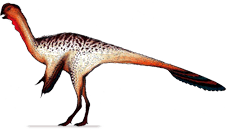
The problem with oviraptorosaurs from the Ganzhou area is that they're mostly pummeled to bits when quarries are being relieved of their rocks for building materials, which is why all of those described from this area thus far have been fragmentary. However, Nakangia, found loitering at the Ganzhou Museum of Natural History in 2013 after being dropped off by a kind-hearted local farmer three years earlier, is known from a fair chunk of a skeleton. And it adds to an already impressive roll-call of "egg snatchers" known from the Nanxiong Formation of Ganzhou.
Nankangia jiangxiensis, Ganzhousaurus nankangensis, Jiangxisaurus ganzhouensis, an as-yet-unnamed oviraptorid from the Nanxiong Basin and Banji long, all lived in the same time and place. But the unique shape of their lower jaw suggests they each occupied a distinct ecological niche and thus avoided eating each other into extinction. For example: the straight jaw of Nankangia suggests its mouth was unable to gape as wide as other oviraptorosaurs and was more suited to procuring and processing smaller foods, such as leaves and seeds, as part of a primarily herbivorous diet.
The naming of Ganzhou oviraptorids has become something of a yearly occurrence, and their numbers were bolstered further by Huanansaurus ganzhouensis in 2015, Tongtianlong limosus in 2016, and the "unnamed oviraptorid" which was christened Corythoraptor jacobsi in 2017.
Nankangia jiangxiensis, Ganzhousaurus nankangensis, Jiangxisaurus ganzhouensis, an as-yet-unnamed oviraptorid from the Nanxiong Basin and Banji long, all lived in the same time and place. But the unique shape of their lower jaw suggests they each occupied a distinct ecological niche and thus avoided eating each other into extinction. For example: the straight jaw of Nankangia suggests its mouth was unable to gape as wide as other oviraptorosaurs and was more suited to procuring and processing smaller foods, such as leaves and seeds, as part of a primarily herbivorous diet.
The naming of Ganzhou oviraptorids has become something of a yearly occurrence, and their numbers were bolstered further by Huanansaurus ganzhouensis in 2015, Tongtianlong limosus in 2016, and the "unnamed oviraptorid" which was christened Corythoraptor jacobsi in 2017.
Etymology
Nankangia is named for the Chinese administrative unit of Nankang City.
The species epithet, jiangxiensis,
combines "Jiangxi" (Jiangxi Province) and the Latin "ensis" (from).
ZooBank registry: urn:lsid:zoobank.org:act:D3C8151C-970B-4944-AA4C-E913E73F64D8.
Discovery
The remains of Nankangia were discovered in the Nanxiong Formation, Nankang City, Ganzhou, Jiangxi Province, China, in 2010 by a local farmer who donated them to the Ganzhou Museum of Natural History.
The holotype (GMNH F10003) is a partial lower jaw and partial skeleton including five back vertebrae, one and one-half hip vertebrae, nine complete and two partial tail vertebrae, both
shoulders, an incomplete wishbone, a nearly complete right upper arm bone, all of the right and part of the left hip, both thighs, a right shin, and some ribs. The right thigh is shorter than the left one and has a bony growth close to the knee-end which may have been a pathology that stunted its growth.


