




Pronunciation: jee-RAF-uh-TIE-tuhn
Meaning: Giant Giraffe
Author/s: Paul (1988)
Synonyms: See below
First Discovery: Lindi, Tanzania
Acta Ordinal: #344
Giraffatitan brancai
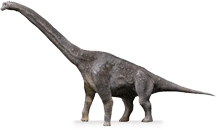
For almost a century, Giraffatitan was Brachiosaurus brancai, the African version of everyone's second favourite sauropod from the USA and, funnily enough, the short-snouted, high-skulled colossus that many folks envisage when they think of Brachiosaurus.
In 1988, Greg Paul noticed some differences between this African form and the North American name-bearer Brachiosaurus altithorax, mainly in the proportions of its vertebrae and more slender build, and created a sub-genus, Brachiosaurus (Giraffatitan) brancai. Then George Olshevsky went a step further by announcing a standalone Giraffatitan in 1991, although most experts remained sceptical.
A skull (USNM 5730) found at Felch Quarry 1 in Colorado's Garden Park in 1883 (the one that apparently inspired O.C. Marsh when building his Yale "Brontosaurus" mount in 1931) was tentatively assigned to Brachiosaurus in 1998 and highlighted further differences between the African and North American forms. But it took a thorough review in which Mike Taylor showed that Giraffatitan and Brachiosaurus differed in size, shape, and proportion of every comparable body part to convince the scientific community that Giraffatitan was its own dinosaur.
Although no longer a species of Brachiosaurus, Giraffatitan is still a brachiosaurid (the Brachiosaurus-anchored family of sauropods who are renowned for their long forelimbs) and, based on relatively complete material, it's amongst the largest known dinosaurs. The likes of Argentinosaurus, Puertasaurus, and Futalognkosaurus may be bigger, but their remains are a bit hit-and-miss, while the legendary Amphicoelias fragillimus, which may be the largest land animal that has ever lived, is based on a single vertebra that probably crumbled to dust where it lay, if it ever existed at all.
A twelve-metre tall Giraffatitan specimen has pride of place in Berlin's Natural History Museum and is currently the tallest mounted dinosaur skeleton in the world. But it's a subadult, and specimen HMN XV2, represented by a fibula 13% larger than the corresponding bone of the Berlin specimen, would add at least another metre and a half to its height.
A skull (USNM 5730) found at Felch Quarry 1 in Colorado's Garden Park in 1883 (the one that apparently inspired O.C. Marsh when building his Yale "Brontosaurus" mount in 1931) was tentatively assigned to Brachiosaurus in 1998 and highlighted further differences between the African and North American forms. But it took a thorough review in which Mike Taylor showed that Giraffatitan and Brachiosaurus differed in size, shape, and proportion of every comparable body part to convince the scientific community that Giraffatitan was its own dinosaur.
Although no longer a species of Brachiosaurus, Giraffatitan is still a brachiosaurid (the Brachiosaurus-anchored family of sauropods who are renowned for their long forelimbs) and, based on relatively complete material, it's amongst the largest known dinosaurs. The likes of Argentinosaurus, Puertasaurus, and Futalognkosaurus may be bigger, but their remains are a bit hit-and-miss, while the legendary Amphicoelias fragillimus, which may be the largest land animal that has ever lived, is based on a single vertebra that probably crumbled to dust where it lay, if it ever existed at all.
A twelve-metre tall Giraffatitan specimen has pride of place in Berlin's Natural History Museum and is currently the tallest mounted dinosaur skeleton in the world. But it's a subadult, and specimen HMN XV2, represented by a fibula 13% larger than the corresponding bone of the Berlin specimen, would add at least another metre and a half to its height.
(Branca's titanic giraffe)Etymology
Giraffatitan is a derived from "giraffa" (itself derived from the arabic "zirafah") because of its front-high, giraffe-like appearance, and "titan" (for the giant archaic Greek Gods reknowned for their great size, not to mention disturbing habits).
The species epithet, brancai, honours Professor Wilhelm von Branca, the head of the Geologisch-Paläontologische Institut und Museum der Königliche Friedrich-Wilhelm Universität zu Berlin.
Synonyms
Brachiosaurus brancai (Janensch, 1914)Brachiosaurus fraasi (Janensch, 1914)
"Abdallahsaurus"
"Blancocerosaurus"
"Ligomasaurus"
"Mtapaisaurus"
"Salimosaurus"
"Wangonisaurus"
Discovery
The remains of Giraffatitan were discovered at "Site D" in the
Tendaguru beds of Tanzania, one kilometre northeast of Tendaguru Hill, near Lindi, east Africa, in 1909. Further fossils were found at many quarries over the course of that year, including "Site IX", "Site N" and "Site ab". "Site cc" and "Site Y" were opened in 2010, but the most significant finds were made at "Site S" which was opened in 1909 and worked into 1912. Werner Janensch assigned these remains to Brachiosaurus as a second species — Brachiosaurus brancai — in 1914. The Lectotype (HMN SII, referred to by Janensch as "Skellet S II") is a partial skeleton comprising skull fragments
including jaw bones, eleven neck vertebrae, neck
ribs, seven back vertebrae, a nearly complete set of back ribs,
tail vertebrae and chevrons, shoulder girdles missing the right shoulder blade, left and right forelimbs and a right hand, both pubes, a partial left thigh, right calf and shin bones.


