









Pronunciation: deen-YAY-ro-SOR-us
Meaning: Dinheiro lizard
Author/s: Bonaparte and Mateus (1999)
Synonyms: None known
First Discovery: Lourinhã, Portugal
Acta Ordinal: #458
Dinheirosaurus lourinhanensis
After its discovery in 1987 and excavation between '87 and '92, Pedro Dantas briefly described a dinosaur specimen from Porto Dinheiro Cliffs. Then, in 1998, he lumped it with Lourinhasaurus alenquerensis: a fellow Portuguese sauropod that spent many a year erroneously assigned to Apatosaurus.
Bonaparte and Mateus renamed these fossils Dinheirosaurus a year later, having realised that Lourinhasaurus and the new specimen lacked comparable bones, and assigned it to Diplodocidae, based mainly on comparisons to Diplodocus and its clan from the Morrison Formation of North America. However, doubts remained. Further discoveries could either cement the pair as separate taxa or prove their synonymy, but ultimately, new remains were not required.
In 2011, Mannion and colleagues announced that Dinheirosaurus was distinct after studying previously undescribed tail vertebrae and ribs of the holotype, and in doing so, it became the first confirmed diplodocid known from Europe. But it couldn't relax for long. Four years later, Tschopp, Mateus and Benson recovered Dinheirosaurus as the closest relative of the North American Supersaurus. So close, in fact, that they suggested the former should be synonymised with the latter, thus creating the new combination Supersaurus lourinhanensis, but more of those holotype fossils must be prepared from their feature-obscuring rock matrix to confirm or refute this hypothesis.
Bonaparte and Mateus renamed these fossils Dinheirosaurus a year later, having realised that Lourinhasaurus and the new specimen lacked comparable bones, and assigned it to Diplodocidae, based mainly on comparisons to Diplodocus and its clan from the Morrison Formation of North America. However, doubts remained. Further discoveries could either cement the pair as separate taxa or prove their synonymy, but ultimately, new remains were not required.
In 2011, Mannion and colleagues announced that Dinheirosaurus was distinct after studying previously undescribed tail vertebrae and ribs of the holotype, and in doing so, it became the first confirmed diplodocid known from Europe. But it couldn't relax for long. Four years later, Tschopp, Mateus and Benson recovered Dinheirosaurus as the closest relative of the North American Supersaurus. So close, in fact, that they suggested the former should be synonymised with the latter, thus creating the new combination Supersaurus lourinhanensis, but more of those holotype fossils must be prepared from their feature-obscuring rock matrix to confirm or refute this hypothesis.
Etymology
Dinheirosaurus is derived from "Dinheiro" (from Porto Dinheiro where the holotype was discovered) and the Greek "sauros" (lizard).The species epithet, lourinhanensis, is derived from "Lourinha" (for the nearby town of Lourinhã) and the Latin "ensis" (from).
Discovery
The remains of Dinheirosaurus were discovered in the Amoreira-Porto Novo Member of the Lourinhã Formation at Praia de Porto Dinheiro cliff, near Lourinhã, Estremadura, west-central Portugal, by Mr. Carlos Anunciação in 1987.
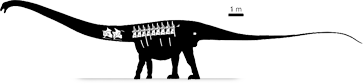
The holotype (ML 414, housed at Museu da Lourinhã) consists of two neck (cervical) vertebrae, nine back (dorsal) vertebrae plus a partial tenth, some ribs, a fragment of hip bone (pubis), three partial tail (caudal) vertebrae and more than 100 gastroliths.
Antunes and Mateus provisionally assigned a second specimen (ML 418: two vertebrae) from Moita dos Ferreiros to Dinheirosaurus as aff. Dinheirosaurus in 2003. It was reviewed, along with the holotype, in 2011 by Mannion et al who concluded that it doesn't belong to Dinheirosaurus. But it does belong to the same family, suggesting the presence of a second diplodocid sauropod in the Late Jurassic of Portugal.


