




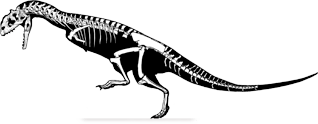
Pronunciation: mah-JOON-guh-SOR-us
Meaning: Majunga lizard
Author/s: René Lavocat (1955)
Synonyms: See below
First Discovery: Majunga, Madagascar
Acta Ordinal: #204
Majungasaurus crenatissimus
Etymology
Majungasaurus is derived from "Majunga" (the Madagascan province now known as Mahajanga) and the Greek "sauros" (lizard). The species epithet (or specific name), crenatissimus, is derived from the Latin "crenatus" (notched) and the Greek "issimus" (most or very much), in reference to the numerous serrations on both the front and rear edges of its teeth. Megalosaurus crenatissimus (Depéret, 1896)
Dryptosaurus crenatissimus (Depéret and Savornin, 1928)
Majungatholus atopus (Sues and Taquet, 1979) In 1895 Charles Depéret happened upon six specimens of a new carnivorous dinosaur in Madagascar's Mahajanga basin that he named Megalosaurus crenatissimus.|1| But he didn't assign a holotype, indicate whether the bones belonged to a single individual, or even suggest that they were all from the same quarry, and by the following year, thought it "entirely probable" that they pertained to a new species of Dryptosaurus based on features of its teeth. Depéret and Justin Savornin officially named Dryptosaurus crenatissimus in 1928.|2|
Sixty years later, René Lavocat found a lower jaw in the same general area, which he referred to Depéret's critter. Then realised it was neither Megalosaurus-nor-Dryptosaurus-like and coined Majungasaurus, though presumably, he didn't rate the older specimens because he assigned his new dentary (MNHN.MAJ 1) as the neotype (new type specimen).|3| Sampson, however, regarded all of these remains as dubious, and after the discovery of a domed theropod skull, he announced that Majungatholus atopus, based on a skull roof that had been wrongly identified as the property of a pachycephalosaur by Sues and Taquet in 1979,|4| should be the valid name for this Madagascan theropod.|5| After many more discoveries and comparisons, Sampson was forced into a flip-flop; Lavocat's specimen is, in fact, valid and diagnostic, and by the laws of priority it has, well, priority. Majungasaurus crenatissimus is Majungasaurus crenatissimus once more, and the old neotype (MNHN.MAJ 1) is the new type specimen. Again.
Although specific (and accurate) locality data for all proposed specimens of Majungasaurus is hit and miss prior to the "Mahajanga Basin Project" in 1993, it's likely that they all hail from the Maevarano Formation around the Village of Berivotra, southeast of the port city of Mahajanga, Madagascar.
Habitat
During the Late Cretaceous, Madagascar was a seasonal sub-tropical realm with floodplains and shallow sandy rivers flowing from Madagascar’s central highlands, but virtually a desert during the dry season. Majungasaurus was the apex land-dwelling predator in an ecosystem it shared with a small-bodied theropod, Masiakasaurus knopfleri and a large titanosaur, Rapetosaurus krausei, and when water was abundant, so was vegetation and aquatic life, including fish, frogs, turtles, and several species of crocodyliforms. But when the water dried up, creating environmental stress, Majungasaurus thoroughly exploited all available resources for nutritional needs: intensely tooth-marked elements on multiple Majungasaurus specimens match Majungasaurus teeth, showing that they had no problem cannibalising each other.


