









Pronunciation: DEE-a-man-TEE-nuh-SOR-us
Meaning: Diamantina River Lizard
Author/s: Hocknull et al. (2009)
Synonyms: None known
First Discovery: Queensland, Australia
Acta Ordinal: #676
Diamantinasaurus matildae
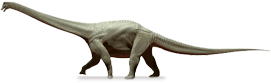
Australia's fossil register is a bit on the thin side compared to those of similar-sized continents such as North America, South America and Africa. But in Diamantinasaurus—nicknamed "Matilda" after A.B. "Banjo" Paterson's famous Australian song "Waltzing Matilda"—they have one of the oldest titanosaurs known from anywhere in the world. And it's their most complete sauropod too.
Initially known from a partial skeleton that was later bolstered by non-duplicate remains from the same area and almost certainly the same individual, Diamantinasaurus died in a billabong alongside Wintonotitan (another sauropod tagged "Clancy") after being mired in mud and became unwilling bait in a huge predator trap. Dying, crying and potentially stinking, they would have been irresistible to the local carnivores, including Australovenator (a theropod tagged "Banjo") who jumped in to take advantage of a free feast and—Boom!—became mired and died too.
Although found mingled together, the enormous sauropod bones and those of the puny theropod were easily sorted by size difference and their respective group characteristics, and the two sauropods differ significantly too. Family ties notwithstanding (they're both titanosaurs), Diamantinasaurus is much more robust than Wintonotitan, and the latest research has it pegged as a member of Lithostrotia—the armoured branch of Titanosauria—though, funnily enough, no armour plates have been discovered.
In 2015, University of New England PhD student Ada Klinkharmer borrowed some Diamantinasaurus bones to have them CT scanned at Mt Isa Hospital in the hope of creating a 3d model for biomechanical studies. The application of virtual force, she hoped, would show how its limbs dealt with stress in certain situations, and if, for example, its hind legs were capable of sustaining the critter's entire body weight when rearing up to feed from tree tops. Unfortunately, a 3d model was not forthcoming because the scanner was unable to sustain the weight of a Diamantinasaurus thighbone.
Initially known from a partial skeleton that was later bolstered by non-duplicate remains from the same area and almost certainly the same individual, Diamantinasaurus died in a billabong alongside Wintonotitan (another sauropod tagged "Clancy") after being mired in mud and became unwilling bait in a huge predator trap. Dying, crying and potentially stinking, they would have been irresistible to the local carnivores, including Australovenator (a theropod tagged "Banjo") who jumped in to take advantage of a free feast and—Boom!—became mired and died too.
Although found mingled together, the enormous sauropod bones and those of the puny theropod were easily sorted by size difference and their respective group characteristics, and the two sauropods differ significantly too. Family ties notwithstanding (they're both titanosaurs), Diamantinasaurus is much more robust than Wintonotitan, and the latest research has it pegged as a member of Lithostrotia—the armoured branch of Titanosauria—though, funnily enough, no armour plates have been discovered.
In 2015, University of New England PhD student Ada Klinkharmer borrowed some Diamantinasaurus bones to have them CT scanned at Mt Isa Hospital in the hope of creating a 3d model for biomechanical studies. The application of virtual force, she hoped, would show how its limbs dealt with stress in certain situations, and if, for example, its hind legs were capable of sustaining the critter's entire body weight when rearing up to feed from tree tops. Unfortunately, a 3d model was not forthcoming because the scanner was unable to sustain the weight of a Diamantinasaurus thighbone.
(Matilda's Diamantina lizard)Etymology
Diamantinasaurus is derived from "Diamantina" (for the Diamantina River
which runs near the type locality) and the Greek "sauros" (lizard).The species epithet, matildae, is a reference to Waltzing Matilda, one of Australia's National songs, written by Banjo Patterson in Winton ("Matilda Country") in 1895. ZooBank registry: urn:lsid:zoobank.org:act:6BE2173E-5438-4F9A-8978-745C3379F90D.
Discovery
The remains of Diamantinasaurus were discovered at the "Matilda Site" (AODF 85) in the Winton Formation, Elderslie Sheep Station, 60 km
west-northwest of Winton, west-central Queensland, Australia, by volunteers from the Australian Age of Dinosaurs Museum of Natural History.
The holotype (AODF 603) is a partial skeleton, including the right shoulder blade (scapula), right and left upper arms (humeri),
a right lower arm bone (ulna), a near complete right "hand",
some fragmentary ribs, hip bones (right and left pubes and ischia, and left ilium), and the right thigh, shin, calf and ankle. More non-duplicate remains from the same area, and probably the same individual, were excavated over five seasons between 2006–2010 and described in 2014. Another specimen (AODF—Australian Age of Dinosaurs—603) from Belmont sheep station was described in 2016 and includes the first partial sauropod skull identified from the Australian continent.


