









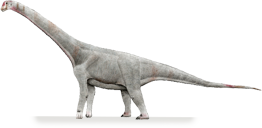
Pronunciation: choo-BOOT-i-SOR-us
Meaning: Chubut lizard
Author/s: del Corro (1974)
Synonyms: None known
First Discovery: Chubut Province, Argentina
Acta Ordinal: #244
Chubutisaurus insignis
Chubutisaurus was discovered in 1961 in Argentina's Cerro Barcino Formation by a rancher known only as Martinez. Unfortunately, he died a short time later, and it took four years to coax the fossil site's whereabouts from his widow. But excavations began in February of 1965, and after a full thirty days of round-the-clock digging, its well-preserved colossal fossils were out of the ground.
A preliminary report arrived almost a decade later courtesy of Guillermo del Corro, in which Chubutisaurus was announced simply as a sauropod that "seems to have some relationship with Bothriospondylus madagascariensis" from the Late Jurassic. Perplexing was how two critters, apparently some 60 million years apart, could be so similar, and after much deliberation, palaeontologists concluded that the supposed latest Cretaceous rocks of Cerro Barcino that Chubutisaurus called home had been (possibly) horrendously misdated.
As of 2020, forty-six years have passed since del Corro's paper, and no one has as much as poked Chubutisaurus with a stick. It appears to be one of the most primitive titanosaurs (the "wide load" sauropods), loitering close to the base of Titanosauria and lacking the specialized characteristics that are present in many of its Argentinian relatives. If titanosaurs were sandwiches, Chubutisaurus would be cheese and tomato.
A preliminary report arrived almost a decade later courtesy of Guillermo del Corro, in which Chubutisaurus was announced simply as a sauropod that "seems to have some relationship with Bothriospondylus madagascariensis" from the Late Jurassic. Perplexing was how two critters, apparently some 60 million years apart, could be so similar, and after much deliberation, palaeontologists concluded that the supposed latest Cretaceous rocks of Cerro Barcino that Chubutisaurus called home had been (possibly) horrendously misdated.
As of 2020, forty-six years have passed since del Corro's paper, and no one has as much as poked Chubutisaurus with a stick. It appears to be one of the most primitive titanosaurs (the "wide load" sauropods), loitering close to the base of Titanosauria and lacking the specialized characteristics that are present in many of its Argentinian relatives. If titanosaurs were sandwiches, Chubutisaurus would be cheese and tomato.
(Notable Chubut Lizard)Etymology
Chubutisaurus is derived from "Chubut" (the Argentinian province in which it was discovered) and the Greek "sauros" (lizard).The species epithet, insignis, means "notable" or "distinguished" in Latin, and refers to the size of its limb bones and vertebrae.
Discovery
The remains of Chubutisaurus were discovered in the Bayo Overo Member of the Cerro Barcino Formation (aka the Gorro Frigio Formation), Paso de Indios, Chubut Province, Argentina, in 1961. Quite unexpectedly, five teeth from a carnivorous dinosaur tagged "Megalosaurus inexpectatus" (Del Corro, 1966) were found within the sediment that covered the bones.
The Holotype (MACN 18.222 - housed at Museo Argentino de Ciencias Naturales) consists of an incomplete cervical (neck) vertebra, a dorsal (back) vertebra, nine caudal (tail) vertebrae, a left humerus (upper arm), a left femur (thigh) and "…other limb bones in a good state of preservation".
 • Paul GS (2010) "


