









Pronunciation: bay-bay-long
Meaning: Baby dragon
Author/s: Pu et al. (2017)
Synonyms: None known
First Discovery: Henan, China
Acta Ordinal: #970
Beibeilong sinensis
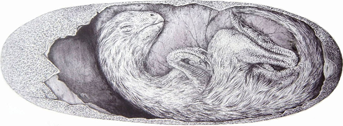
Gigantoraptor aside, the total number of potentially gigantic oviraptorosaurs known from any time of any place that warrant their own name is, well, zero, and when palaeontologists did have the opportunity to describe one, representing the caenagnathid branch of oviraptorosaurs, they dragged their heels for 23 years. To be fair, though, there were some issues beyond their control. A Chinese Farmer found a sandstone block containing the remains that would become Beibeilong in Henan at a time when China had totally lost control of its illegal fossil exports, and it swiftly made its way onto the black market and into North America—unprepared—in 1993. "The stone company" cleaned said specimen, and worldwide fame followed a feature in a cover article for National Geographic Magazine in 1996. Then "Baby Louis", as it came to be known, in honour of article photographer Louis Psihoyos, was acquired in 2001 by the Indianapolis Children's Museum, where it formed the centrepiece of a public exhibit.
However, because the specimen—consisting of an embryonic individual associated with 6-8 of the largest known dinosaur eggs—had left China without the relevant permission, no self-respecting scientific journal would touch it with a bargepole until repatriation, which took the best part of 12 years.
But studies began in earnest in 2013 once Baby Louis had eventually made its way back home, and Hanyong Pu and colleagues officially named and described Beibeilong—the baby dragon—in 2017.
(Baby Dragon from China)Etymology
Beibeilong is derived from the Chinese Pinyin "beibei" (baby) and "long" (dragon). The species epithet, sinensis, is derived from the Latin "sinae" (China) and "ensis" (from), referring to its discovery in China.
ZooBank registry: urn:lsid:zoobank.org:act:D7C44CBC-B55B-4D7A-87F3-5811441B7546.
Discovery
The remains of Beibeilong were discovered in the Gaogou Formation at Heimaogou, 2km east of Zhaoying Village, Yangcheng Township, Xixia County, Henan Province, People's Republic of China, by local farmer Mr Zhang Fengchen between December 1992 and early 1993.
The holotype (HGM 41HIII1219, housed in the Henan Geological Museum [HGM] of Zhengzhou) is a small, semi-articulated skeleton ("Baby Louie") associated with a partial nest of 6-8 eggs. Beibeilong is the first caenagnathid skeleton to be discovered alongside caenagnathid eggs known as Macroelongatoolithus.


