









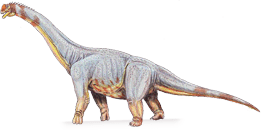
Pronunciation: pa-RAL-i-TIE-tuhn
Meaning: Shoreline Giant
Author/s: Smith et al. (2001)
Synonyms: None known
First Discovery: Marsa Matruh, Egypt
Acta Ordinal: #507
Paralititan stromeri
Egyptian dinosaurs are a little thin on the ground, and those that have been found were mostly fragmentary and/or suffered a second extinction when their adopted Munich Museum home was blown to buggery by RAF bombers on April 25, 1944, during WWII. But things were looking up in 2000 when Joshua Smith and chums discovered Paralititan in tidal flat deposits of the Baharija Formation at Marsa Matruh, which was the first reported tetrapod (four-limbed critter) from this area since Ernst Stromer's science-shaking haul of dinosaurs in the 1930s.
Known only from predator-scavenged spine, hip and forelimb material, Paralititan is frustratingly incomplete, but sometimes a little is more than enough to impress, and the sheer size of its fossils is mind-blowing. Based on a 1.69-meter-long humerus—the longest of any known Cretaceous sauropod—speculation is rife that Paralititan was upwards of fifty tons in weight and size-wise perhaps second only to Argentinosaurus (arguably the largest land animal ever), and so must have been a biomechanical wonder to avoid becoming mired in mud.
Paralititan was a coastal swamp dweller, living amongst mangroves along the south shore of the Tethys Sea, which was no place for a herbivorous sauropod. It shared its home with Spinosaurus, Carcharodontosaurus, and Bahariasaurus which are three of the largest carnivores that have ever lived. But Paralititan was a titanosaur and titanosaurs were no ordinary sauropods. Named after primordial Greek deities and seemingly worthy of their favour, titanosaurs had the knack of being perfectly equipped for their environment which is why they out-lived all other sauropods. Strange-shaped bones found amongst Paralititan remains have been interpreted as back and flank-fortifying armour plates to repel attacks from the area's super-sized predators, and while some palaeontologists doubt this identification, we like to think that Mother Nature did her bit to even the odds.
Known only from predator-scavenged spine, hip and forelimb material, Paralititan is frustratingly incomplete, but sometimes a little is more than enough to impress, and the sheer size of its fossils is mind-blowing. Based on a 1.69-meter-long humerus—the longest of any known Cretaceous sauropod—speculation is rife that Paralititan was upwards of fifty tons in weight and size-wise perhaps second only to Argentinosaurus (arguably the largest land animal ever), and so must have been a biomechanical wonder to avoid becoming mired in mud.
Paralititan was a coastal swamp dweller, living amongst mangroves along the south shore of the Tethys Sea, which was no place for a herbivorous sauropod. It shared its home with Spinosaurus, Carcharodontosaurus, and Bahariasaurus which are three of the largest carnivores that have ever lived. But Paralititan was a titanosaur and titanosaurs were no ordinary sauropods. Named after primordial Greek deities and seemingly worthy of their favour, titanosaurs had the knack of being perfectly equipped for their environment which is why they out-lived all other sauropods. Strange-shaped bones found amongst Paralititan remains have been interpreted as back and flank-fortifying armour plates to repel attacks from the area's super-sized predators, and while some palaeontologists doubt this identification, we like to think that Mother Nature did her bit to even the odds.
(Stromer's tidal giant)Etymology
Paralititan is derived from the Greek "paralos" (near the sea) and "titan" (giant) referring to its discovery in coastal deposits and its hugeness. The species epithet, stromeri, honours Ernst Stromer von Reichenbach, German palaeontologist, and pioneer of dinosaur excavations in this area. ZooBank registry: urn:lsid:zoobank.org:act:AA790512-15EE-4DDF-B123-855C2763523F.
Discovery
The only fossils of Stromer's Shoreline giant were discovered in the Baharija (aka Bahariya) Formation at Marsa Matruh, 524km northwest of Egypt's capital, Cairo, at a quarry which was partially excavated by Stromer in 1911. The Holotype (CGM 81119 - housed at the Geological Museum of Cairo) includes tail vertebrae, spine, hip and shoulder bones, a toe and a humerus.


