







Pronunciation: SIT-i-puh-tih
Meaning: Lord of the funeral pyre
Author/s: Clark, Norell, Barsbold (2001)
Synonyms: None known
First Discovery: Ömnögovi, Mongolia
Acta Ordinal: #508
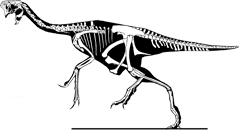
Citipati osmolskae
As far as awesomely-named dinosaurs go, Citipati is right up there with "Demon of the river of death" (Stygimoloch) and "Short-necked horny goat god" (Brachytrachelopan).
"Lord of the funeral pyre" was the largest known oviraptorid until the hulking Gigantoraptor stole its thunder, but it still ranks as one of the most amazing fossils known to science for a couple of reasons: (1) its discovery in a brooding position atop nests full of eggs—some of which contained fossilized embryos—did much to cement the dinosaur/bird behavioural link, and (2) its skull is so amazingly complete and well-preserved that a CT doughnut had no problems recreating the intricacies of its brain case in glorious 3D.
(Osmólska's Lord of the Funeral Pyre)Etymology
Citipati is derived from the Sanskrit words "citi" (funeral pyre) and "pati" (lord).
More specifically, Citipati is named for two dancing skeletons—the Citipati, notorious cemetary loiterers from Tibetan Buddhist mythology.
The species epithet, osmolskae (os-MOL-skee), honors Mongolian palaeontologist Halszka Osmólska.
Discovery
The first fossils of Citipati were discovered in the Djadokhta Formation of Ukhaa Tolgod, Ömnögovi, Mongolia.The holotype (IGM 100/978) is an almost complete skeleton including the skull.
Preperators
Amy Davidson of the AMNH prepared the holotype specimen over the course of many years, due to the technical challenges of extracting the
porous and fragile bone from the surrounding matrix.
Habitat
Famous for its "Flaming Cliffs" (known locally as Bayanzag), the Djadokhta Formation lies within Central Asia's Gobi Desert, and in the Late Cretaceous was mostly desert and dunes with the odd oasis and brook for water. Pretty much the same as it is now, actually.


