









Pronunciation: ty-RAN-o-MY-mus
Meaning: Tyrant mimic
Author/s: Hattori et al. (2023)
Synonyms: None known
First Discovery: Fukui, Japan
Acta Ordinal: #1141
Tyrannomimus fukuiensis
(Fukui Tyrannosauroid Mimic)Etymology
Tyrannomimus is derived from the Greek "tyrannos" (tyrant) and "mimos" (mimic), referring to tyrannosauroids: a family of carnivorous "tyrant lizards", who have a similar vertical ridge on the ilium bone of their hips.
The species epithet, fukuiensis, means "from Fukui" in Latin.
Discovery
The remains of Tyrannomimus were discovered in the Kitadani Formation (Tetori Group), in Bonebed 1 of the Kitadani Dinosaur Quarry, Katsuyama, Fukui, Japan.
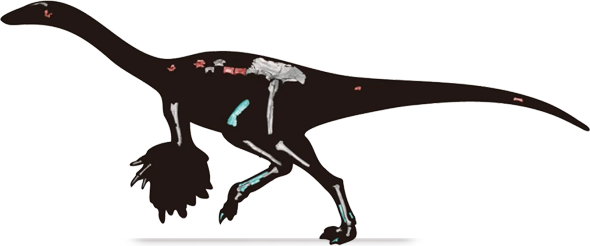
The holotype (FPDM-V-11311) is a disarticulated but associated skeleton including two parts of the braincase, several back, hip and tail vertebrae, and fragments of ilium (hip bones). The paratype (FPDM-V-10295) is a partial left leg and right foot. Referred specimens include a skull bone (FPDM-V-11313), 3 back and 4 hip vertebrae (FPDM-V-11314–11316 and FPDM-V-11317—11320), 3 upper arm bones (FPDM-V-11321—11323), 10 finger bones (FPDM-V-8579, 8580, 8945, 11324—11329, 11332), 6 ilia (FPDM-V-9348, 11333—11337), a thigh (FPDM-V-11338), 3 shins (FPDM-V-11339—11341), 3 metatarsals (FPDM-V-11343—11345), and 4 toe bones (FPDM-V-11343, 11346—11348).
Preparators
Fukui Prefectural Dinosaur Museum preperators.


