




Pronunciation: la-KWIN-tuh-SOR-ruh
Meaning: La Quinta lizard
Author/s: Barrett et al. (2014)
Synonyms: None known
First Discovery: Tachira, Venezuela
Acta Ordinal: #888
Laquintasaura venezuelae
Due in no small part to a total lack of fossil evidence, paleontologists assumed that the tropical latitudes of South America were just too inhospitable for dinosaurs and therefore it was a region that they just didn't inhabit. Laquintasaura changed all that in some style as it's not only from the "tropical belt" of northern South America but also one of the oldest ornithischians known from anywhere to boot. On top of that it's the first dinosaur known from Venezuela and expands the exclusive club of dinosaurs that are suffixed with the feminine form of lizard (saura) rather than the ever-popular masculine form (saurus).
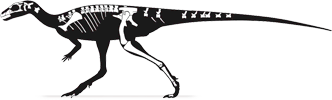
The fox-sized, bipedal and presumably nimble Laquintasaura lived around 200 mya, right after the Triassic-Jurassic mass extinction that wiped out a number of competing reptile groups and cleared a path for dinosaurs to achieve global dominance. At least four specimens were found together which is the earliest example of social behaviour in ornithischian dinosaurs, and unlike its later-living relatives, most of whom were primarily if not entirely herbivorous, the long, slightly curved, serrated and ridged teeth of Laquintasaura hint at omnivory—they could and would eat pretty much anything—which is always an advantage when bouncing back from a cataclysmic event.
The fox-sized, bipedal and presumably nimble Laquintasaura lived around 200 mya, right after the Triassic-Jurassic mass extinction that wiped out a number of competing reptile groups and cleared a path for dinosaurs to achieve global dominance. At least four specimens were found together which is the earliest example of social behaviour in ornithischian dinosaurs, and unlike its later-living relatives, most of whom were primarily if not entirely herbivorous, the long, slightly curved, serrated and ridged teeth of Laquintasaura hint at omnivory—they could and would eat pretty much anything—which is always an advantage when bouncing back from a cataclysmic event.
(La Quinta lizard of Venezuela)Etymology
Laquintasaura is derived from "La Quinta" (the rock formation in which it was found) and the Greek "saura" (feminine form of lizard).
The species epithet, venezuelae, refers to its discovery in Venezuela.
ZooBank registry: urn:lsid:zoobank.org:act:FB7736E3-B653-4861-9F0F-A0001F89C641.
Discovery
The remains of Laquintasaura were discovered in the La Quinta Formation, Tachira State, in the Andes mountains of Venezuela, South America, by Prof. Marcelo Sánchez of the University of Zurich. The holotype (MBLUZ - P.1396) is an isolated tooth, but hundreds of elements have been discovered at the same site, including the paratypes MBLUZ P.5017 (a piece of left femur), MBLUZ P.5018 (a left ischium) and MBLUZ P.5005 (a left ankle joint). No forelimb material is known, and foot material is rare.


