Pronunciation: or-ni-THIS-kee-uh
Author: Harry Seeley
Year: 1888
Meaning: Bird hips (see etymology)
Locomotion: Some two legs, some four legs
Synonyms: Predentata (Marsh, 1894)
(Padian and May, 1993)Definition
All dinosaurs closer to Triceratops than to birds.
In a nutshell
Ornithischia is an extinct order of beaked, herbivorous, "bird-hipped" dinosaurs.
About
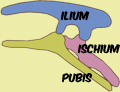
Ornithischia emerges in the Late Triassic as the sister lineage to Saurischia, marked by a dramatic reorientation of the pelvis: the pubis swings backward, creating the "bird-hipped" condition that gives the clade its name. Yet the paradox is immediate and enduring — birds themselves are not ornithischians, but saurischians, so the lineage that literally means "bird-hipped" has no direct tie to the origin of birds. Its earliest members are small, bipedal herbivores with lightly built skeletons and a distinctive innovation at the tip of the jaw: the predentary, a unique bone found in no saurischian, anchoring a keratinous beak that would become a hallmark of the clade. With this new cutting edge, early ornithischians begin to explore fresh herbivorous strategies in landscapes still ruled by pseudosuchians and early saurischians. Their evolution is quiet but foundational, assembling the anatomical toolkit that will one day fuel one of the most inventive herbivore radiations in vertebrate history.
Ornithischia's defining character is defensive creativity. As the clade matures, it explodes into an astonishing array of herbivorous strategies: the plated stegosaurs, the tank-like ankylosaurs, the fleet-footed ornithopods, the dome-headed pachycephalosaurs, and the horned ceratopsians. Their skulls become engines of processing power, packed with dental batteries and muscular cheeks; their bodies sprout armour, spikes, frills, and display structures that turn defence into spectacle. Ornithischians rarely chase gigantism or predation. Instead, they refine the arts of protection, social signalling, and efficient herbivory. Their internal dynamics reveal a lineage that thrives on morphological invention and ecological versatility — a clade that answers danger with ingenuity.
Ornithischians reach their zenith in the Late Cretaceous, dominating herbivore communities across Asia, North America, and Europe. Ceratopsians and hadrosaurs become the backbone of many ecosystems, while ankylosaurs and pachycephalosaurs fill specialised niches. Their decline at the K–Pg boundary is absolute — unlike saurischians, no ornithischian lineage survives the extinction event. Yet their legacy endures. They represent one of the most imaginative herbivore radiations in vertebrate history, a lineage that turned armour, ornamentation, and chewing mechanics into evolutionary art forms. Ornithischia remains the clade that shows how far herbivory can be pushed in form, function, and spectacle.
Click here to search Dinochecker's database for Ornithischia.
Etymology
Ornithischia is derived from the Greek "ornith" (bird) and "iskhion" (hip joint).
Relationships
References
• Seeley HG (1888) "On the classification of the fossil animals commonly named Dinosauria". Proceedings of the Royal Society of London, 43(258–265): 165-171. DOI: 10.1098/rspl.1887.0117.
• Sereno PC (1986) "Phylogeny of the bird-hipped dinosaurs (order Ornithischia)". National Geographic Research, 2(2): 234-256
• Holtz Jr TR (2008) "The Most Complete, Up-to-Date Encyclopedia for Dinosaur Lovers of All Ages".
• Fastovsky DE and Weishampel DB (2012) "Dinosaurs: A Concise Natural History".
• Baron MG, Norman DB and Barrett PM (2017) "A new hypothesis of dinosaur relationships and early dinosaur evolution". Nature. 543 (7646): 501–506. DOI: 10.1038/nature21700.
• Langer MC, Ezcurra MD, Rauhut OWM, Benton MJ, Knoll F, McPhee BW, Novas FE, Pol D and Brusatte SL (2017) "Untangling the dinosaur family tree". Arising from Baron et al. 2017. Nature, 551(7678): E1–E3. DOI: 10.1038/nature24011.
• Baron MG, Norman DB and Barrett PM (2017) "A reply to Langer et al. 2017 ". Nature, 551(7678): E4–E5. DOI: 10.1038/nature24012.
• Baron MG (2018) "Pisanosaurus mertii and the Triassic ornithischian crisis: could phylogeny offer a solution?". Historical Biology: An International Journal of Paleobiology, 31(8): 967–981. DOI: 10.1080/08912963.2017.1410705.
• Button DJ, Porro LB, Lautenschlager S, Jones MEH and Barrett PM (2023) "Multiple pathways to herbivory underpinned deep divergences in ornithischian evolution".
Current Biology, 33: 1–9.
DOI: 10.1016/j.cub.2022.12.01.