Pronunciation: STEG-o-SOR-ee-uh
Author: O.C. Marsh
Year named: 1877
Meaning: Roof lizards (see etymology)
Locomotion: Quadrupedal (four legs)
Synonyms: None known
[Sereno 2005]Definition
The most inclusive clade containing Stegosaurus stenops but not Ankylosaurus magniventris.
About
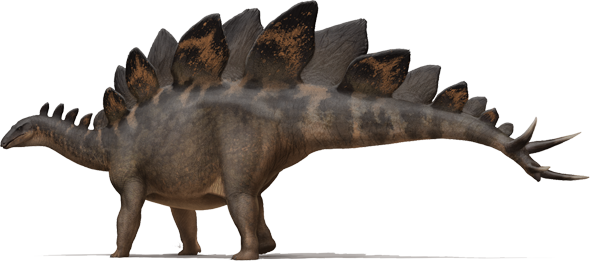
Although stegosaurs are instantly recognizable for their twin rows of oversized plates and spines marching from neck to tail, their story stretches across a surprisingly narrow slice of time. These four-legged armoured herbivores appear in the Middle Jurassic and persist only into the Early Cretaceous, leaving fossils on every continent except Antarctica and Australia. Their earliest representatives appear in Middle Jurassic rocks across Europe, China, Argentina, and Morocco, all arising within the Bajocian–Callovian interval: Loricatosaurus priscus from the Middle Callovian Oxford Clay of Cambridgeshire; Huayangosaurus taibaii from the Bathonian–Callovian beds of the Shaximiao Formation in Sichuan; Isaberrysaura mollensis from Bajocian strata of Argentina’s Los Molles Formation; and Adratiklit boulahfa from the Bathonian El Mers II Formation of Morocco.
Click here to search DinoChecker for stegosaurs.
Etymology
Stegosauria is derived from the Greek " stego" (roof, cover), "sauros" (lizard) and "ia" (neuter plural), named for the plates that run down their backs, which O.C. Marsh originally assumed lay flat and overlapping, like roof tiles.
Relationships
References
• Marsh OC (1877) "New order of extinct Reptilia (Stegosauria) from the Jurassic of the Rocky Mountains". The American Journal of Science, Series 3, 14: 513-514.
• Dong Z, Z Tang and SW Zhou (1982) "Note on the new Mid-Jurassic stegosaur from Sichuan Basin, China". Vertebrata PalAsiatica, 20(1): 83-87. [Huayangosaurus taibaii.]
• Carpenter K, Miles CA and Cloward K (2001) "New Primitive Stegosaur from the Morrison Formation, Wyoming". In Carpenter K (ed) "The Armored Dinosaurs".
• Fastovsky DE and Weishampel DB (2005) "Stegosauria: Hot Plates". Page 107-130 in Fastovsky and Weishampel (eds.) "The Evolution and Extinction of the Dinosaurs".
• Maidment SCR, Norman DB, Barrett PM and Upchurch P (2008) "Systematics and phylogeny of Stegosauria (Dinosauria: Ornithischia)". Journal of Systematic Palaeontology. 6(4): 367–407. DOI: 10.1017/S1477201908002459. [Loricatosaurus priscus.]
• Salgado L, Canudo JI, Garrido AC, Moreno-Azanza M, Martínez LCA, Coria RA and Gasca JM (2017) "A new primitive Neornithischian dinosaur from the Jurassic of Patagonia with gut contents".
Scientific Reports, 7: 42778. DOI: 10.1038/srep42778. [Isaberrysaura mollensis.]
• Raven TJ and Maidment SCR (2017) "A new phylogeny of Stegosauria (Dinosauria, Ornithischia)". Palaeontology, 60(3): 401–408. DOI: 10.1111/pala.12291.
• Maidment SCR, Raven TJ, Ouarhache D and Barret PM (2019) "North Africa's first stegosaur: Implications for Gondwanan thyreophoran dinosaur diversity". Gondwana Research, 77: 82-97. [Adratiklit boulahfa.]
• Dieudonne PE, Cruzado-Caballero P, Godefroit P and Tortosa T (2021) "A new phylogeny of cerapodan dinosaurs". Historical Biology, 33(10): 2335–2355. DOI: 10.1080/08912963.2020.1793979.
• Raven TJ and Maidment SC (2018) "The systematic position of the enigmatic thyreophoran dinosaur Paranthodon africanus, and the use of basal exemplifiers in phylogenetic analysis". PeerJ, 6: e4529. DOI: 10.7717/peerj.4529.
• Raven TJ, Barrett PM, Joyce CB and Maidment SC (2023) "The phylogenetic relationships and evolutionary history of the armoured dinosaurs (Ornithischia: Thyreophora)". Journal of Systematic Palaeontology, 21(1): 2205433. DOI: 10.1080/14772019.2023.2205433.