









Pronunciation: oon-en-LAHG-ee-a
Meaning: Half bird
Author/s: Novas and Puerta (1997)
Synonyms: None known
First Discovery: Rio Negro, Argentina
Acta Ordinal: #428
Unenlagia comahuensis
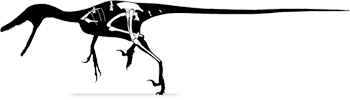
Unenlagia was originally hailed as an early bird. Actually, it was hailed as half a bird — from the Mapudungun "uñen" (half) and "lag" (bird) — reflecting its liminal status somewhere between small theropods and "true" birds... which are small theropods. It sports a curious suite of features, as you would expect from a so-called "transitional" critter. But it's the position of its wings that has courted the most attention and put several groups of palaeontologists in a flap.
Initially, the shoulder girdle of Unenlagia was thought to be quite supple and capable of a broad range of movements. While it lacked the freedom required for Yoga or kung fu, the scapula (shoulder blade), positioned atop the rib cage and parallel to the spine, was capable of an up-and-down motion, which mirrors the flapping seen in modern birds. Later, some palaeontologists revised this view by lowering the shoulder joint and positioning the scapula upwards and across the ribcage, in a more orthodox non-bird theropod style. But that would mean the wings couldn't be lifted above its back and so a full flap, and thus powered flight, was unpossible.
With an estimated length of at least 3 meters, Unenlagia was probably too big to fly, regardless of its shoulder design. But it does belong to a family (Unenlagiinae) that contains a flying member in the form of Rahonavis, which suggests one of two things: (1) unenlagiines were flyers and Unenlagia represents a flightless lineage of oddballs, or (2) unenlagiines were flightless and Rahonavis were the evolutionary oddballs that took to the skies.
Initially, the shoulder girdle of Unenlagia was thought to be quite supple and capable of a broad range of movements. While it lacked the freedom required for Yoga or kung fu, the scapula (shoulder blade), positioned atop the rib cage and parallel to the spine, was capable of an up-and-down motion, which mirrors the flapping seen in modern birds. Later, some palaeontologists revised this view by lowering the shoulder joint and positioning the scapula upwards and across the ribcage, in a more orthodox non-bird theropod style. But that would mean the wings couldn't be lifted above its back and so a full flap, and thus powered flight, was unpossible.
With an estimated length of at least 3 meters, Unenlagia was probably too big to fly, regardless of its shoulder design. But it does belong to a family (Unenlagiinae) that contains a flying member in the form of Rahonavis, which suggests one of two things: (1) unenlagiines were flyers and Unenlagia represents a flightless lineage of oddballs, or (2) unenlagiines were flightless and Rahonavis were the evolutionary oddballs that took to the skies.
(Half bird from Comahue)Etymology
In the Mapudungun (Earth language) of the Mapuche (Earth people) — one of the indigenous inhabitants of south-central Chile and southwestern Argentina — Unenlagia is derived from "uñen" (half) and "lag" (bird) because the describers considered it to be a stepping stone between birds and basal theropods.The species epithet, comahuensis (KOH-muh-hoo-EN-sis) honours the Comahue region of Argentina where the fossils were found.
Discovery
The first fossils of Unenlagia were discovered in the Portezuelo Formation, Sierra del Portezuelo, Neuquen Province, Comahue, Argentina in 1996.
The holotype (MCF PVPH 78) is a partial skeleton, lacking the skull but including vertebrae, a sacrum (fused hip vertebrae), ribs, a scapula (shoulder blade), a humerus (upper arm bone), a partial pelvis, a femur (thigh) and a tibia (shin).


