









Pronunciation: ROO-gops
Meaning: Wrinkle Face
Author/s: Sereno, Wilson and Conrad (2004)
Synonyms: None known
First Discovery: Agadez, Niger
Acta Ordinal: #552
Rugops primus
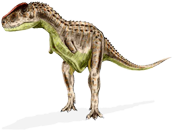
Rugops is known only from a partial skull which showed that it was a member of Abelisauridae: the carnivores with stocky legs, fused ankles, and tall but short ornamented skulls that terrorized the southern continents at the same time as tyrannosaurs were bossing the North. Its snout is riddled with wrinkles, dimples and divets and sports a row of seven pits on the top edge of each side that may have anchored scales or armour, or scales and armour, or perhaps a soft tissue display piece akin to a cocks-comb, of a colour that the opposite sex found incredibly alluring.
The skull of Rugops is lightly built, with slender bones and weight-saving fenestrae (windows). Like all abelisaurs, its teeth were relatively small, which led some experts to surmise that it was more suited to sticking its gnarly face into the guts of a real predator's stinking castoff than hunting for itself. Piranhas have small teeth compared to those of crocodiles, but they can certainly kill. That said, piranha and crocodiles, and all predators, for that matter, aren't too proud to scavenge if the opportunity presents itself. A meal is a meal, and there's no shame in eating something that can't fight back.
It's a long-held theory that Africa was the first landmass to split from the supercontinent of Gondwana — Laurasia's southern counterpart that would further fragment into present-day South America, Antarctica, Madagascar, Australia, the Arabian Peninsula and the Indian subcontinent — around 120 million years ago. However, the discovery of Rugops in 95 million-year-old deposits in Niger and a remarkably similar abelisaurid upper jaw from similar-age rocks in Argentina suggests Africa was still connected to the South American edge of Gondwana, at the very least by intermittent land bridges, as recently as the Cenomanian (95 mya).
The skull of Rugops is lightly built, with slender bones and weight-saving fenestrae (windows). Like all abelisaurs, its teeth were relatively small, which led some experts to surmise that it was more suited to sticking its gnarly face into the guts of a real predator's stinking castoff than hunting for itself. Piranhas have small teeth compared to those of crocodiles, but they can certainly kill. That said, piranha and crocodiles, and all predators, for that matter, aren't too proud to scavenge if the opportunity presents itself. A meal is a meal, and there's no shame in eating something that can't fight back.
It's a long-held theory that Africa was the first landmass to split from the supercontinent of Gondwana — Laurasia's southern counterpart that would further fragment into present-day South America, Antarctica, Madagascar, Australia, the Arabian Peninsula and the Indian subcontinent — around 120 million years ago. However, the discovery of Rugops in 95 million-year-old deposits in Niger and a remarkably similar abelisaurid upper jaw from similar-age rocks in Argentina suggests Africa was still connected to the South American edge of Gondwana, at the very least by intermittent land bridges, as recently as the Cenomanian (95 mya).
(First wrinkle face)Etymology
Rugops is derived from the Latin "Ruga" (wrinkle) and the Greek "opsi" (face) because of the wrinkled texture of the external skull surface. The species epithet, primus, means "first" in Latin and refers to its significance as one of the earliest abelisaurids.
Discovery
The first fossils Rugops were discovered in the Echkar Formation (Tegama Group) at Iguidi, near In Abangharit, Agadez, Niger, by Hans Larsson at the tailend of a Paul Sereno-led expedition in 2000.
The holotype (MNN IGU1) is a partial skull.
Preparators
E. Dong, A. Gray and T. Keillor.


