









Pronunciation: hah-GREE-fuss
Meaning: Ha's Griffin
Author/s: Zanno and Sampson (2005)
Synonyms: None known
First Discovery: Utah, USA
Acta Ordinal: #574
Hagryphus giganteus
Oviraptorosaurs aren't particularly popular in North America. In fact, the discovery of Hagryphus boosted the total species count to... three. Still, three is better than two, whichever way you slice it, and this latest find from Utah proved that the so-called "Egg Snatchers" ventured further south on the continent than previous evidence suggested.
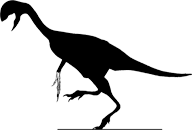
Unfortunately, Hagryphus fossils amount to just a robust hand and some foot bones. However, using better-represented relatives as a yardstick for proportionate upscaling, palaeontologists reckon they belong to a critter some 3 meters long, which is 40% bigger than its next largest, non-Asian relative: Chirostenotes. Hagryphus probably sported a short and deep snout, strong toothless jaws and honey-combed skull bones typical of oviraptorosaurs, and possibly a crest. But those features can only be confirmed when a head is found attached to a body with matching hands and feet.
Unfortunately, Hagryphus fossils amount to just a robust hand and some foot bones. However, using better-represented relatives as a yardstick for proportionate upscaling, palaeontologists reckon they belong to a critter some 3 meters long, which is 40% bigger than its next largest, non-Asian relative: Chirostenotes. Hagryphus probably sported a short and deep snout, strong toothless jaws and honey-combed skull bones typical of oviraptorosaurs, and possibly a crest. But those features can only be confirmed when a head is found attached to a body with matching hands and feet.
Etymology
Hagryphus is the first dinosaur to combine mythological entities from two different countries: "Ha", the Egyptian God of the western dessert and "Gryphon" (Griffin), a treasure-guarding part-lion part-eagle from Ancient Greece which, according to folklorist Adrienne Mayor, may have entered their mythology after the discovery of Protoceratops fossils in Altai mountain gold mines. Funnily enough, Hagryphus has nothing to do with Gods, Egypt or Greece, though it was discovered in a Utah dessert and had claws.The species epithet, giganteus, refers to its size compared to Asian oviraptorosaurs.
Discovery
The remains of Hagryphus were discovered in the Kaiparowits Formation (middle unit) at Grand Staircase-Escalante National Monument, Garfield County, Utah, USA, by Michael Getty in 2002. The holotype (UMNH VP 12765) consists of an incomplete but articulated left hand (aka manus) and the "wrist-end" from the larger of two left forearm bones (aka distal radius).
Preparator
Mike Getty.


