









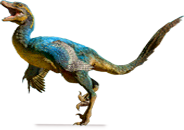
Pronunciation: DAH-ly-uhn-SOR-us
Meaning: Dalian lizard
Author/s: Shen et al. (2017)
Synonyms: None known
First Discovery: Liaoning Province, China
Acta Ordinal: #974
Daliansaurus liaoningensis
By the time Daliansaurus appeared in print in June of 2017, China had already yielded eleven confirmed troodontid dinosaurs in Sinornithoides, Sinovenator, Mei, Sinusonasus, Jinfengopteryx,
Anchiornis, Xixiasaurus, Linhevenator, Xiaotingia, Philovenator and
Eosinopteryx. But there was also a twelfth, in the form of Liaoningvenator, which hadn't received much love.
Daliansaurus and Liaoningvenator were found in the exact same area and named in the space of a month, with three palaeontologists from the same Dalian Museum, where both specimens are housed, forming the core of two teams that described both critters, including Shen Cai-zhi, who was the lead author... twice.
That all struck us as slightly odd, and we wondered if, not for the first time, two teams had described the same specimen. But not so. The pair are distinct and were analysed using different datasets (Brusatte 2014 vs Tsuihiji 2016, respectively), which, as you might expect, yielded wildly differing results regarding the relationships within Troodontidae.
The Daliansaurus analysis crunched far more data than that of Liaoningvenator (152 taxa scored for 853 characters, plus the additions for Daliansaurus and Sinosonasus) and resulted in a new sub-family of troodontids—Sinovenatorinae—which was defined as "the most inclusive clade including Sinovenator changii but not Troodon formosus, Saurornithoides mongoliensis, Anchiornis huxleyi, Archaeopteryx lithographica, Gallus gallus, Unenlagia comahuensis, or Dromaeosaurus albertensis". Funnily enough, Sinovenator, Sinusonasus magnodens, Mei long and Daliansaurus are currently the only recognised sinovenatorines, and they all hail from Lujiatun village in the Fuxin-Yixian Basin of China's Liaoning Province.
Although similar in the characteristics of the upper jaw, teeth and hip vertebrae, Daliansaurus and its Liaoning brethren differ in several features of the skull, hands and pelvis, and the former can be distinguished from all troodontids from anywhere else with a glance at its feet. Troodontids, like dromaeosaurids, are renowned for the enormous claw which adorns their retractable second toes. But Daliansaurus has an equally long claw on its fourth toe too, and it's considerably more robust.
The Daliansaurus analysis crunched far more data than that of Liaoningvenator (152 taxa scored for 853 characters, plus the additions for Daliansaurus and Sinosonasus) and resulted in a new sub-family of troodontids—Sinovenatorinae—which was defined as "the most inclusive clade including Sinovenator changii but not Troodon formosus, Saurornithoides mongoliensis, Anchiornis huxleyi, Archaeopteryx lithographica, Gallus gallus, Unenlagia comahuensis, or Dromaeosaurus albertensis". Funnily enough, Sinovenator, Sinusonasus magnodens, Mei long and Daliansaurus are currently the only recognised sinovenatorines, and they all hail from Lujiatun village in the Fuxin-Yixian Basin of China's Liaoning Province.
Although similar in the characteristics of the upper jaw, teeth and hip vertebrae, Daliansaurus and its Liaoning brethren differ in several features of the skull, hands and pelvis, and the former can be distinguished from all troodontids from anywhere else with a glance at its feet. Troodontids, like dromaeosaurids, are renowned for the enormous claw which adorns their retractable second toes. But Daliansaurus has an equally long claw on its fourth toe too, and it's considerably more robust.
(Dalian lizard from Liaoning)Etymology
Daliansaurus is derived from "Dalian" (for the Dalian Natural History Museum (DNHM) in Dalian City,
where its fossils are housed) and the Greek "sauros" (lizard).The species epithet, liaoningensis, means "from Liaoning" in Latin.
Discovery
The remains of Daliansaurus were discovered in the Yixian Formation at Lujiatun Village, Beipiao City, Liaoning Province, China.
With its neck and head arched backwards to almost touch its spine, one arm tucked to the side and the other wrapped around its body, and the tail curved forwards on its right side, the holotype of Daliansaurus (DNHM D2885) had wrapped itself into a nice neat package around 45cm long and 25 high. Parts of the skull had
been reconstructed and are
not genuine fossils, but its hands and feet preserve many fine details.


