









Pronunciation: jee-AN-yen-hwa-long
Meaning: Jianianhua dragon
Author/s: Xu et al. (2017)
Synonyms: None known
First Discovery: Liaoning, China
Acta Ordinal: #968
Jianianhualong tengi
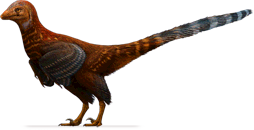
China's Early Cretaceous-aged Jehol Group has yielded spectacular specimens of theropod dinosaurs, including many fossils of troodontids, which, along with dromaeosaurids, are considered to be the closest relatives of birds. As such, direct evidence for the prescence of feathers on the Chinese troodontids Jinfengopteryx, Xiaotingia and Eosinopteryx was expected, as was the dismissal of their integument as nothing but degraded collagen fibres by the Birds Are Not Dinosaurs squad. Recently, even several right-minded palaeontologists began to have their doubts: not about the presence of feathers but of the troodontid affinities of those three species.
But right on cue, along came Jianianhualong from the Yixian Formation at Baicai Gou with large asymetrical feathers on the forelimbs, hindlimbs and tail, arranged in a similar fashion to those seen on the dromaeosaurid Microraptor and the "first bird" Archaeopteryx, and strutted its way straight to Troodontidae on the theropod branch of the dinosaurian family tree, flipping the bird at BANDits on the way.
(Teng's Jianianhua dragon)Etymology
Jianianhualong is derived from "Jianianhua" (the Chinese company that supported this study) and the Chinese Pinyin "long" (dragon).
The species epithet, tengi (TENG-ee), honours Ms Fangfang Teng, who secured the specimen for study.


