









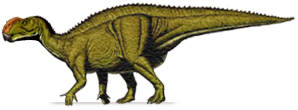
Pronunciation: al-ti-RIEN-us
Meaning: High snout
Author/s: Norman (1998)
Synonyms: None known
First Discovery: Dornogov, Mongolia
Acta Ordinal: #442
Altirhinus kurzanovi
(Kurzanov's high nose)
Etymology
Altirhinus is derived from the Latin "altus" (high) and the Greek "rhin-(rhis)" (nose or snout) named "in recognition of the highly arched nasal bones of the skull which give the snout of this animal a distinctively elevated profile."
The species epithet, kurzanovi (koor-zuh-NOH-vie), is named in honour of Dr. Sergei M. Kurzanov of the Paleontology Institute of the Russian Academy of Sciences, Moscow.
Discovery
The remains of Altirhinus were discovered in the Khuren Dukh Formation (previously part of the Shinekhudag/Shinehuduk Formation), 30km south of the town of Choir (Choyr), Dornogovi Province, Mongolia, by Dr. Sergei M. Kurzanov, during a collaborative
expedition by the Palaeontological Institute of the Soviet (later Russian)
Academy of Sciences and the Geological Institute of the Mongolian Academy of
Sciences, in 1981. The holotype (PIN 3386/8) includes a skull which is well preserved on the left side, plus bits of hands, feet, shoulders and hip.
Paratypes:
PIN 3386/7 (3387): A partial skull, upper and lower jaws, 10 teeth, fragmentary back and neck vertebrae, ribs, sternum, shoulder, arm and hand bones.
PIN 3386/9 (3389): Both shoulder girdles, a whole right arm and most of the left, both nearly complete hands, both pubes, left thigh, right shin, both shankbones, both ankles, foot and toe bones, and 34 tail vertebrae.
PIN 3390: Broken limb and girdle bones, chevron and jaw fragments, and an isolated tooth, from a small individual, possibly a juvenile.
PIN 3391: A partial left foot, a shin, 4 partial vertebra and some bone fragments, also from a small individual, possibly a juvenile.
All remains were originally assigned to Iguanodon orientalis.


