









Pronunciation: VEK-tee-RAP-tuh
Meaning: Isle of Wight thief
Author/s: Longrich et al. (2021)
Synonyms: None known
First Discovery: Isle of Wight, UK
Acta Ordinal: #1095
Vectiraptor greeni
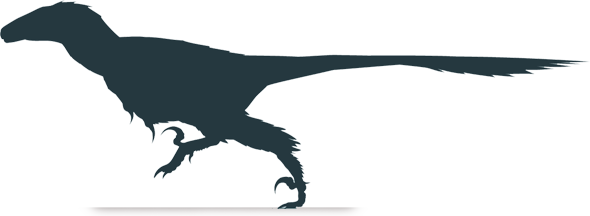
Vectiraptor greeni is a large-bodied "raptor" known from two back vertebrae and a chunk of hip uncovered at Compton Bay on the Isle of Wight. Air?filled hollows from a bird-like breathing sustem inside extremely thick-walled bones, tall spine?like projections, and broad, reinforced joints show it was a powerfully muscled predator, roughly wolf-sized and almost certainly feathered like its close relatives. The animal died and lay buried until 2004, when storms and waves finally eroded the sea cliff that had kept its bones hidden for nearly 125 million years. Yet almost two more decades passed before researchers from the Universities of Bath and Portsmouth recognised the fossils as belonging to a new species.
Although discovered in Europe, its anatomy places Vectiraptor within Eudromaeosauria—a group of sickle-clawed predators otherwise known almost entirely from North America and Asia—suggesting Early Cretaceous dispersal routes, perhaps intermitant land bridges caused by receding oceans, that once allowed dinosaurs to move between these ancient landmasses.
Although discovered in Europe, its anatomy places Vectiraptor within Eudromaeosauria—a group of sickle-clawed predators otherwise known almost entirely from North America and Asia—suggesting Early Cretaceous dispersal routes, perhaps intermitant land bridges caused by receding oceans, that once allowed dinosaurs to move between these ancient landmasses.
(Green's Isle of Wight Thief)Etymology
Vectiraptor is derived from "Vectis" (the Latin name for the Isle of Wight) and the Greek "raptor" (thief).
The species epithet, greeni, honours amatuer palaeontologist Mick Green of Brighstone, Isle of Wight, who discovered two-thirds of its remains.
Discovery
The first two fossils of Vectiraptor were discovered in the Wessex Formation at Compton Bay on the Isle of Wight, England, by Mick Green in 2004.
A third fossil was found by the late Nick Chase.
Because all elements were discovered within a few metres of each other over a short period of time, they are interpreted as belonging to a single individual. All were subsequently donated to the Isle of Wight County Museum.
The holotype (IWCMS 2021.31.1—3) is a couple of back vertebrae (IWCMS 2021.31.1 and IWCMS 2021.31.2) collected by Green, and a partial block of fused hip vertebrae (IWCMS 2021.31.3) collected by Chase.
Large dromaeosaurid teeth previously reported from Wight might belong to Vectiraptor.
Preparator
Mick Green.


