









Pronunciation: KOZ-mo-SEH-ruh-tops
Meaning: Ornate Horned Face
Author/s: Sampson et al. (2010)
Synonyms: None known
First Discovery: Utah, USA
Acta Ordinal: #752
Kosmoceratops richardsoni
We don't know what it is about water and dinosaurs but, like Mogwai, they just don't mix well. Take the Romanian 'saurs of Hateg Island; small but perfectly formed "dwarf" versions of their mainland relatives living amongst the islands of a Late Cretaceous European archipelago. And then there are the chasmosaurines of Laramidia—a Late Cretaceous landmass separated from Appalachia by the Western Interior Seaway, and again by a natural barrier segregating north from south—who were so spun out by the isolation that they forgot the family blueprint.
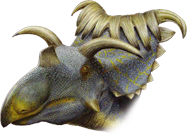
Typically, chasmosaurines had a long and relatively narrow, bony neck frill but Kosmoceratops went for the short and wide approach. Its frill is twice as wide as it is long, though it isn't very long, but in the mind of a ceratopsian it's not the size of your appendage but how much bling you can hang on your face that counts. Fifteen horny structures—ten hook-like horns on the top of its frill, a blunt blade-like nose horn, a small horny protuberance jutting out from each cheek and two sideways-angled brow horns—earned Kosmoceratops a name that means "ornate horn face" and made it the Mack Daddy of horned dinosaurs.
Typically, chasmosaurines had a long and relatively narrow, bony neck frill but Kosmoceratops went for the short and wide approach. Its frill is twice as wide as it is long, though it isn't very long, but in the mind of a ceratopsian it's not the size of your appendage but how much bling you can hang on your face that counts. Fifteen horny structures—ten hook-like horns on the top of its frill, a blunt blade-like nose horn, a small horny protuberance jutting out from each cheek and two sideways-angled brow horns—earned Kosmoceratops a name that means "ornate horn face" and made it the Mack Daddy of horned dinosaurs.
Etymology
Kosmoceratops is derived from the Latin "kosmos" (ornate) and the Greek "keras" (horn) and "ops" (face), because of its ridiculously ornate horned face.The species epithet, richardsoni (RICH-ard-SON-i), honors Scott Richardson, the volunteer who discovered two skulls of this animal in 2007. ZooBank registry: urn:lsid:zoobank.org:act:676322FC-4BDB-4FAA-9CF6-B31157F315BC.
Discovery
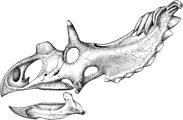 The first remains of Kosmoceratops were discovered by Scott Richardson in 2006/07 at UMNH Locality VP 890 in the Kaiparowits Formation, Grand Staircase-Escalante National Monument, southern Utah, USA, which during the mid-late Cretaceous was part of the lost island continent of Laramidia, separated from Eastern North America (Appalachia) by a shallow sea known as the Western Interior Seaway.
The holotype (UMNH VP 17000) is a nearly complete skull which, before being officially named, was referred to as "Kaiparowits new taxon A".
Referred specimens include (UMNH VP 12198) the disarticulated skull of a subadult individual.


