




Pronunciation: ee-PEE-or-NITH-o-MIEM-us
Meaning: Aepyornis mimic
Author/s: Tsogtbaatar et al. (2017)
Synonyms: None known
First Discovery: Ömnögovi, Mongolia
Acta Ordinal: #977
Aepyornithomimus tugrikinensis
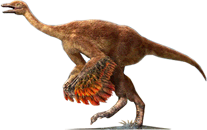
Although Mongolia's Djadokhta Formation has been intensively surveyed for close to a century and yielded some spectacular dinosaur fossils, ornithomimosaurs have proven particularly elusive with just two specimens being recorded from the Ukhaa Tolgod locality since 1927, neither of which were worthy of an official name. The third "ostrich mimic" to be reported from this formation, and the first from the Tugrikin Shireh locality, is the most complete yet. And while still little more than a fraction of a skeleton it bears enough diagnostic features to set it apart from its relatives, and fully deserves its own name: Aepyornithomimus tugrikinensis.
(Aepyornis mimic from Tugrikin)Etymology
Aepyornithomimus is derived from "Aepyornis" (the largest of the flightless birds, known colloquially as "elephant birds") and the Latin "mimus" (mimic), referring to its similar foot structure.
The species epithet, tugrikinensis, means "from Tugrikin" in Latin.
Zoobank registry: urn:lsid:zoobank.org:act:EE073A9C-F692-46EB-9EE4-FE151FD5C4E4.
Discovery
The remains of Aepyornithomimus were discovered at Central Sayr in the Tugrikin Shireh (aka Tögrögiin Shiree) locality of the Djadokhta Formation, Ömnögovi (South Gobi) Aimag (Province), Mongolia, by Mr. Shigeru Suzuki during a joint Japanese (HMNS)-Mongolian (IPG) paleontological expedition to the Gobi Desert in 1994.
The holotype (MPC-D 100/130) is an articulated left foot, ankle and heel.


