









Pronunciation: oss-tra-low-veh-NAY-tuhr
Meaning: Southern (Hemisphere) hunter
Author/s: Hocknull et al. (2009)
Synonyms: None known
First Discovery: Winton, Australia
Acta Ordinal: #674
Australovenator wintonensis
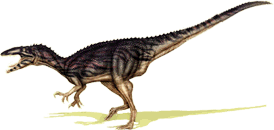
Banjo (after A. B. "Banjo" Paterson, who penned Waltzing Matilda) is a nickname bestowed upon what several, mostly Australian, sources were trumpeting as perhaps the most terrifying flesh-eater ever discovered—Australovenator wintonensis, found near Winton, Oz—though it was only six meters in length and lighter than a Right Whale's bollock.
Just like the swagman, Australovenator met its end in a billabong—probably after jumping in to take advantage of two sauropods: Wintonotitan ("Clancy") and Diamantinasaurus ("Matilda"). Mired in mud, Clancy and Matilda became reluctant bait in a long-spanning "predator trap" that used the promise of a free meal to entice Australovenator and other carnivores, who then became mired themselves. Add to those the remains of bivalves, fish, turtles, crocodilians, and rotting plant fossils, and the area probably, at some point, resembled an enormous, stinking broth that no self-respecting predator could resist. And so, over time, more ingredients were added.
Dubbed by authors as "the cheetah of its time" because of its light and agile build, Australovenator fell neatly into a relatively new clade called Megaraptora within Neovanatoridae (itself within Allosauroidea), along with a handful of previously hard-to-classify carnivorous misfits, and may have solved a 28-year-old mystery involving an ankle bone from Victoria, which was long thought to belong to a dwarf Allosaurus. However, some analyses have found megaraptorans to be tyrannosauroids, and thus closer to Tyrannosaurus than to Allosaurus—in which case, the hunt for said ankle bone's owner will continue.
Just like the swagman, Australovenator met its end in a billabong—probably after jumping in to take advantage of two sauropods: Wintonotitan ("Clancy") and Diamantinasaurus ("Matilda"). Mired in mud, Clancy and Matilda became reluctant bait in a long-spanning "predator trap" that used the promise of a free meal to entice Australovenator and other carnivores, who then became mired themselves. Add to those the remains of bivalves, fish, turtles, crocodilians, and rotting plant fossils, and the area probably, at some point, resembled an enormous, stinking broth that no self-respecting predator could resist. And so, over time, more ingredients were added.
Dubbed by authors as "the cheetah of its time" because of its light and agile build, Australovenator fell neatly into a relatively new clade called Megaraptora within Neovanatoridae (itself within Allosauroidea), along with a handful of previously hard-to-classify carnivorous misfits, and may have solved a 28-year-old mystery involving an ankle bone from Victoria, which was long thought to belong to a dwarf Allosaurus. However, some analyses have found megaraptorans to be tyrannosauroids, and thus closer to Tyrannosaurus than to Allosaurus—in which case, the hunt for said ankle bone's owner will continue.
Etymology
Australovenator (Southern Hunter) is derived from the Latin "auster" (south) and "venator" (Hunter), referring to its discovery in the southern hemisphere and its carnivorous diet.
The species epithet, wintonensis, means "from Winton" in Latin.
ZooBank registry: urn:lsid:zoobank.org:act:37AA3C1B-B498-406B-A51C-C3CF8C88A59F.
Discovery
The remains of Australovenator were discovered at the "Matilda Site" (AODF 85) in the Winton Formation, Elderslie Sheep Station, Eromanga Basin, 60 km west-northwest of Winton, west-central Queensland, Australia, by volunteers from the Australian Age of Dinosaurs Museum of Natural History between 2006 and 2009.
The holotype (AODF 604) includes nine serrated teeth, left lower jaw, various ribs, partial legs, partial arms, some fingers and toes.


