









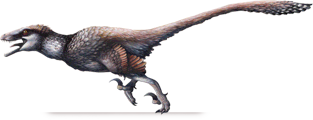
Pronunciation: duh-KO-tuh-RAP-tuh
Meaning: Dakota plunderer
Author/s: DePalma, et al. (2015)
Synonyms: None known
First Discovery: Dakota, USA
Acta Ordinal: #923
Dakotaraptor steini
With a length of about 5.5 meters and an estimated weight of 220 kilograms, Dakotaraptor rivalled Utahraptor as the largest of the dromaeosaurids, but their bauplans were vastly different. Compared to most other dromaeosaurids, Utahraptor is robust with a nearly 1:1 thigh to shin ratio and proportionately shorter feet, typical of a slow but powerful predator.
Conversely, Dakotaraptor is lightly built with proportionately longer feet, and thighs that are close to 20% shorter than its shins. That
lengthening of the lower hindlimb is considered an adaptation for increased cursorality (the ability to run fast), so Dakotaraptor had the potential for exceptional pursuit capabilities comparable to the smallest and most agile dromaeosaurids.
Proportionately, the forelimbs of Dakotaraptor are also exceptionally close to those of smaller dromaeosaurids such as Deinonychus and Dromaeosaurus, and preserve "quill knobs"—reinforced anchor points for non-downy feathers with a stout quill—on the uppermost of two lower arm bones known as the ulna, to support the rigors of flight. However, Dakotaraptor wasn't flying. It was too big and shaped all wrong. But whatever it was doing with its "wings", be it using them for mantling, mating, insualtion, incubation, or intimidation, was so utterly important that evolution ensured those feathers were on there good and proper. Or it wasn't, and they were simply an inherited feature from a flying ancester that Dakotaraptor had no real use for.
Dakotaraptor is the first giant dromaeosaurid known from the Hell Creek Formation, which makes it the first from the Maastrictian age of North America and only the third known from the entire Cretaceous period of that continent. It shared its time and place with a diverse assortment of reptiles, birds, mammals, amphibians, fish, and dinosaurs. But it wasn't the apex predator, despite its size, because the Hell Creek Formation was also the home of Tyrannosaurus rex.
Proportionately, the forelimbs of Dakotaraptor are also exceptionally close to those of smaller dromaeosaurids such as Deinonychus and Dromaeosaurus, and preserve "quill knobs"—reinforced anchor points for non-downy feathers with a stout quill—on the uppermost of two lower arm bones known as the ulna, to support the rigors of flight. However, Dakotaraptor wasn't flying. It was too big and shaped all wrong. But whatever it was doing with its "wings", be it using them for mantling, mating, insualtion, incubation, or intimidation, was so utterly important that evolution ensured those feathers were on there good and proper. Or it wasn't, and they were simply an inherited feature from a flying ancester that Dakotaraptor had no real use for.
Dakotaraptor is the first giant dromaeosaurid known from the Hell Creek Formation, which makes it the first from the Maastrictian age of North America and only the third known from the entire Cretaceous period of that continent. It shared its time and place with a diverse assortment of reptiles, birds, mammals, amphibians, fish, and dinosaurs. But it wasn't the apex predator, despite its size, because the Hell Creek Formation was also the home of Tyrannosaurus rex.
(Stein's Dakota plunderer)Etymology
Dakotaraptor is derived from "Dakota" (for the US State where it was found, and to honour the Dakota First Nations Tribe) and the Latin "raptor" (plunderer, snatcher, robber or thief).
The species epithet, steini, honours palaeontologist Walter W. Stein.
ZooBank registry: urn:lsid:zoobank.org:act:23DB6801-7138-4CCF-96DC-8B377BE0548B.
Discovery
The remains of Dakotaraptor were discovered in the Hell Creek Formation of Harding County, South Dakota, USA, by Robert DePalma in 2005.
The holotype (PBMNH.P.10.113.T) includes a right thigh, both shins, the left anke and heel, some toe bones, one fragmentary back vertebra, ten tail
vertebrae, both arms and some finger bones, all from an adult specimen.
Referred fossils include a right shin (PBMNH.P.10.115.T), an ankle and heel (PBMNH.P.10.118.T) from a more slender specimen, and some isolated teeth (KUVP 156045, PBMNH.P.10.119.T, PBMNH.P.10.121.T, PBMNH.P.10.122.T, PBMNH.P.10.124.T).
What were initially interpreted as pieces of furculae ("wishbones"), including one piece that was part of the holotype and two referred pieces (KUVP 152429 and NCSM 13170, found 9 meters and 16 miles from the holotype respectively) turned out to be trionychid turtle entoplastra (pieces of armour from the underside of the shell).


