




Pronunciation: sie-NOR-nih-THOI-deez
Meaning: Chinese bird form
Author/s: Russell and Dong (1993)
Synonyms: None known
First Discovery: Inner Mongolia, China
Acta Ordinal: #386
Sinornithoides youngi
Not to be confused with Saurornithoides, a bird-like troodontid from Asia, Sinornithoides is... a bird-like troodontid from Asia. Despite sharing a continent and hailing from similar-sounding areas, and being of the same type and bird-like ("ornith-oides" means "bird form" in Latin), the latter is the smaller despite being much older and hails from Inner Mongolia, which is a region of China, while the former was found in Outer Mongolia, which is a country that declared independence from China in 1921.
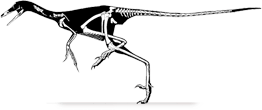
Sinornithoides is based on a virtually complete skeleton and relatively short skull with small teeth, serrated only on the rear edge, that a joint Canada/China expedition hauled from Mongolia's Ejinhoro Formation in 1988. With its snout tucked under its left arm, it was discovered in a similar "sleeping" position to its close relative Mei long, and it was found that way sixteen years earlier, though it cunningly avoided being roasted in the feather by steering clear of active volcanoes. Poor old Mei long.
As a troodontid, Sinornithoides followed the familiar bauplan: small, lithe, bird-like, and possessing one of the highest non-avian encephalization quotients, suggesting advanced behaviour and keen senses. It did, however, differ from other troodontids in that its grasping arms were notably slender, and, on the flip side, the scythe-like "killing claw" on the second toe of each foot was unusually long and robust.
Sinornithoides is based on a virtually complete skeleton and relatively short skull with small teeth, serrated only on the rear edge, that a joint Canada/China expedition hauled from Mongolia's Ejinhoro Formation in 1988. With its snout tucked under its left arm, it was discovered in a similar "sleeping" position to its close relative Mei long, and it was found that way sixteen years earlier, though it cunningly avoided being roasted in the feather by steering clear of active volcanoes. Poor old Mei long.
As a troodontid, Sinornithoides followed the familiar bauplan: small, lithe, bird-like, and possessing one of the highest non-avian encephalization quotients, suggesting advanced behaviour and keen senses. It did, however, differ from other troodontids in that its grasping arms were notably slender, and, on the flip side, the scythe-like "killing claw" on the second toe of each foot was unusually long and robust.
(Young's Chinese bird form)Etymology
Sinornithoides is derived from the Latin "Sinae" (Chinese), and the Greek "ornis" (bird) and "-oides" (like, form), named for its bird-like appearance and discovery in China.
The species epithet, youngi, honors Chung Chien Young (aka C.C Young, aka Yang Zhongjian) the "Father of Chinese vertebrate paleontology".
Discovery
The remains of Sinornithoides were discovered in the Ejinhoro Formation at Huamuxiao, Ordos Basin, Inner Mongolia, northern China, by a joint Canadian/Chinese expedition in 1988.The holotype (IVPP V9612) is an almost complete skeleton.


