





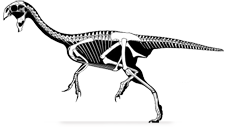
Pronunciation: KAHN
Meaning: Ruler
Author/s: Clark, Norell and Barsbold (2001)
Synonyms: None known
First Discovery: Ömnögovi, Mongolia
Acta Ordinal: #493
Khaan mckennai
Khaan is a crestless member of oviraptororidae, the bird-like maniraptoran dinosaurs with short snouts and deep jaws, and hails from the Late Cretaceous of Ömnögovi, Mongolia. Oviraptorids were mostly herbivorous, or maybe omnivorous. However, they probably weren't, well, egg-nivorous, so the name — derived from the Latin "ovi" (egg) and "raptor" (plunderer) — is a tad unfair.
Khaan is very similar to other Asian oviraptorids, hence lots of initial confusion. At first, its remains were assigned to Ingenia, and its skull wrongly labelled and displayed in New York's American Museum of Natural History as such. Then subtle differences in the form of its hands and the shape of its nostrils (and the fact that the name Ingenia had been assigned to a bug in 1957) hinted at an affinity with fellow crestless Asian oviraptorid Conchoraptor.
In fact, Khaan had enough unique features to warrant its own genus, and got it in 2001. Khaan is now... Khaan, and, along with Minmi, was the shortest non-avian dinosaur name. Then they were trumped in 2004 by Mei, which was knocked off its perch in 2015 by the bat-winged Yi.
Khaan is very similar to other Asian oviraptorids, hence lots of initial confusion. At first, its remains were assigned to Ingenia, and its skull wrongly labelled and displayed in New York's American Museum of Natural History as such. Then subtle differences in the form of its hands and the shape of its nostrils (and the fact that the name Ingenia had been assigned to a bug in 1957) hinted at an affinity with fellow crestless Asian oviraptorid Conchoraptor.
In fact, Khaan had enough unique features to warrant its own genus, and got it in 2001. Khaan is now... Khaan, and, along with Minmi, was the shortest non-avian dinosaur name. Then they were trumped in 2004 by Mei, which was knocked off its perch in 2015 by the bat-winged Yi.
(McKenna's Ruler)
Etymology
In Mongolian, "Khaan" means "ruler".
The species epithet, mckennai (muh-KEN-uh-ie), honours American vertebrate paleontologist Malcolm Carnegie McKenna, "in recognition of his passionate interest in, and efforts towards the exploration of, fossils in Cretaceous deposits of Mongolia."
Sadly, McKenna passed away on March 3rd, 2008.
Discovery
The first fossils of Khaan were discovered at "Mark's Second Egg" in the Djadochta Formation of Ukhaa Tolgod, Gurvan
Tes Somon, Ömnögovi, Mongolia, by a joint expedition of the American Museum of Natural History and the Mongolian Academy of Sciences, in 2000.
The holotype (IGM 100/1127) is an almost complete skeleton, which was discovered alongside a second specimen (IGM 100/1002). The pair were affectionately referred to as "Romeo and Juliet" due to their close proximity, which was fortuitous, as later study of their rear ends suggest they were, in fact, a male and female. A third specimen (IGM 100/973) was found at Granger’s Hill at Ukhaa Tolgod.
Preperators
Amy Davidson


