









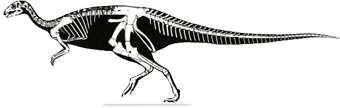
Pronunciation: DRY-o-SOR-us
Meaning: Tree Lizard
Author/s: Marsh (1894)
Synonyms: See below
First Discovery: Wyoming, USA
Acta Ordinal: #82
Dryosaurus altus
Laosaurus altas (Gegenbaur, 1898). Misspelling.
(High Tree Lizard)Etymology
Marsh didn't provide an etymology for Dryosaurus, but it stems from the Greek "drys" (oak, tree) and "sauros" (lizard). Although some sources claim "oak lizard" refers to the shape of its teeth, no teeth were referred to as "oak leaf-shaped" in Marsh's description. In fact, only a single, slightly serrated and ridged tooth was known for the Dryosaurus holotype and it looks nothing like an oak leaf. Instead, "tree lizard" is assumed to be a reference to its woodland habitat. The species epithet, altus, means "high" in Latin, as it was the taller species of Laosaurus, the genus to which its remains were initially assigned, as Laosaurus altus, by Marsh in 1878.
Discovery
The first fossils of Dryosaurus were discovered in YPM "Reed's Quarry 5" at Como Bluff, in the Upper Brushy Basin Member of the Morrison Formation, Albany County, Wyoming, USA, by Samuel Wendell Williston in 1876.
The holotype (YPM 1876) is a reasonably complete skeleton with partial skull, lacking a chunk of vertebrae between the neck and hip, the hip vertebrae entirely, as well as the tail, hands and feet.
Outside the holotype, Dryosauruss is known from a scattered set of referred skeletons and isolated elements collected across the Morrison Formation of Wyoming, Colorado, and Utah.
Wyoming.From the Bone Cabin Quarry near Como Bluff, YPM-1884, found by W.H. Reed at Quarry 13½, preserves the rear half of a skeleton, while AMNH 834 is a partial skeleton lacking the skull. Additional Wyoming material includes USNM-V8419, part of a back vertebrae found by F. Brown in Albany County, and CM-1949, a hind-quarter skeleton (three back vertebrae, 28 from the tail, a hip bone [right ilium], and a hind limb) collected in 1905 by William H. Utterback in 1905, at Elk Mountain near Brown's Ranch in Johnson County, mingled with Diplodocus hind limb material (CM-2098 and -2099). The latter, according to Carpenter and Galton (2018), might represent a hithertto unknown and weirdly-proportioned "dryomorph". Colorado.
Two fragmentary specimens come from western Colorado: CM-21786 from Lily Park in Moffat County, found by James Leroy Kay and Albert C. Lloyd in YD in 1955, and BYU-ESM-171R, found by Rodney Dwayne Scheetz at Sheetz’ Quarry 1 near Uravan in Montrose County, consisting of vertebral fragments, a lower jaw fragment, and limb elements. The latter site, unintentionally exposed by a bulldozer, has since grown exponentially and yielded close to 3,000 fossil fragments, representing at least eight Dryosaurus individuals, ranging from embryonic to juvenile. Utah.
At Dinosaur National Monument, Earl Douglass recovered three referred skeletons: CM-11340, the front half of a very young individual; CM-3392, a skeleton with skull but lacking the tail; and CM-11337, a fragmentary juvenile. A fourth specimen, DNM-1016, a left hip bone (ilium), was found by Monument technician Jim Adams.
These specimens were reassigned by Carpenter and Galton (2018) to a separate species, Dryosaurus elderae—named to honour Ann Schaffer Elder (1958 2009), in recognition of her considerable assistance to Carpenter in his studies at the Carnegie Quarry in Dinosaur National Monument—with CM-3392 as holotype, based on differences in the pelvis, forelimb proportions, and skull anatomy.


