




dinochecker
Welcome to our KUNDUROSAURUS entry...
Archived dinosaurs: 1221
fb twit g+ feed
Dinosaurs from A to Z
Click a letter to view...
A B C D E F G
H I J K L M N
O P Q R S T U
V W X Y Z ?

KUNDUROSAURUS

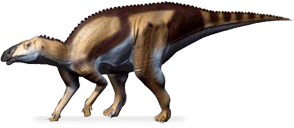
a plant-eating saurolophine hadrosaurid dinosaur from the Late Cretaceous of Russia.
kundurosaurus.png
Pronunciation: kun-DUH-ro-SOR-us
Meaning: Kundur lizard
Author/s: Godefroit et al. (2012)
Synonyms: None known
First Discovery: Kundur, Russia
Discovery Chart Position: #806

Kundurosaurus nagornyi

Four dinosaur-rich localities have been discovered in the Amur/Heilongjiang region of eastern Asia: Jiayin, Wulaga, Blagoveschensk and Kundur, and all have yielded spectacularly complete fossilised hadrosaurids, including a couple of saurolophines. Unfortunately, Kundurosaurus isn't one of them. It is a saurolophine, but its remains amount to a partial skull, a pelvic girdle and a few isolated bones, though they are in a decent state of preservation and sport enough unique features to set it apart from its contemporaries.
(Nagorny's Kundur lizard)Etymology
Kundurosaurus is derived from "Kundur" (the type-locality) and the Greek "sauros" (lizard). The species epithet, nagornyi, honours Vladimir A. Nagorny from the Far Eastern Institute of Mineral Resources, for discovering the Kundur locality in 1990.
ZooBank registry: urn:lsid:zoobank.org:act:F0B031EB-B21B-4AEC-B129-6F4BB5DC7F0C.
Discovery
The remains of Kundurosaurus were discovered in the Udurchukan Formation, "Lower Zeya depression" of the Zeya-Bureya sedimentary basin, Kundur, Ahara County, Amur Region, Far Eastern Russia. The holotype (AENM 2/921) is a partial, disarticulated skull.
Referred material includes more skull fragments, shoulder girdle elements, forelimb bones, and a nearly complete pelvic girdle.
Estimations
Timeline:
Era: Mesozoic
Epoch: Late Cretaceous
Stage: Maastrichtian
Age range: 67-66 mya
Stats:
Est. max. length: 7 meters
Est. max. hip height: ?
Est. max. weight: 2 tons
Diet: Herbivore
References
• Bolotsky YL and Godefroit P (2004) "A new hadrosaurine dinosaur from the Late Cretaceous of Far Eastern Russia". Journal of Vertebrate Paleontology, 24(2): 351-365.
• Horner JR, Weishampel DB and Forster CA (2004) "Hadrosauridae". Page 438–463 in Weishampel, Dodson and Osmólska (eds.) "The Dinosauria: Second Edition".
• Godefroit P, Bolotsky YL, Lauters P (2012) "A New Saurolophine Dinosaur from the Latest Cretaceous of Far Eastern Russia". PLoS ONE, 7(5): e36849. DOI: 10.1371/journal.pone.0036849.
• Xing H, Zhao X, Wang K, Li D, Chen S, Mallon JC, Zhang Y and Xu X (2014) "Comparative osteology and phylogenetic relationship of Edmontosaurus and Shantungosaurus (Dinosauria: Hadrosauridae) from the Upper Cretaceous of North America and East Asia". Acta Geologica Sinica - English Edition, 88 (6): 1623-1652. DOI: 10.1111/1755-6724.12334.
• Paul GS (2016) "The Princeton Field Guide to Dinosaurs: Second Edition".
Email    Facebook    Twitter    Reddit    Pinterest
Time stands still for no man, and research is ongoing. If you spot an error, or want to expand, edit or add a dinosaur, please use this form. Go here to contribute to our FAQ.
All dinos are GM free, and no herbivores were eaten during site construction!
To cite this page:
Atkinson, L. "KUNDUROSAURUS :: from DinoChecker's dinosaur archive".
›. Web access: 06th Mar 2026.
  top