









Pronunciation: ANG-kee-SEH-ruh-tops
Meaning: Near horned face
Author/s: Brown (1914)
Synonyms: See below
First Discovery: Alberta, Canada
Acta Ordinal: #111
Anchiceratops ornatus
By 1910, Barnum Brown had become so utterly bored of discovering Tyrannosaurus and other big-hitting fossils in Montana's Hell Creek that he grabbed his tools, ordered a flat boat, and headed to Alberta's Red Deer River. There, drifting along the meandering waters in a scow dubbed the Mary Jane, Brown traded tyrants for ceratopsians and monotony for mystery. The riverbanks of Alberta’s Red Deer River yielded a treasure trove of horned dinosaurs, including the first remains of Anchiceratops ("near horn face"), a nod to its perceived nearness to two other "horn faces": Monoclonius and Triceratops. Brown saw in its anatomy a transitional form: its frill longer and with smaller windows than that of Monoclonius, yet lacking the full sweep and solid frill of Triceratops. However, Monoclonius has since packed up its frill and moved into Centrosaurus on the other side of the ceratopsian track, rendering Brown’s triangulation more poetic than phylogenetic.
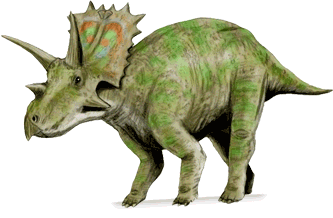
Anchiceratops’ anatomy offered a curious blend of traits that set it apart from its ceratopsid kin. Its neck and spine were notably long, with one more vertebra in each than the going rate for any other ceratopsian. Its pelvis was unusually long too. Yet this elongation was offset by a surprisingly short tail. The skull bore two large brow horns that curved outward then forward, spanning nearly a meter from tip to tip, and a short nasal horn perched above its parrot-like beak. The frill, rectangular and trailing well behind the cranium, was edged with coarse, triangular projections (epoccipitals) and punctuated by two modest openings (fenestrae), while a pair of sideways-pointing bony knobs straddled the midline towards the top edge. Large attachment crests on its upper arms suggest extremely robust and muscular forelimbs. These anatomical quirks hint at a ceratopsid that didn't conform to a transitional blueprint, but instead assembled its own anatomical solutions to environmental problems.
The peculiar proportions of Anchiceratops have led some palaeontologists to propose an unexpected ecological twist. In 1959, Wann Langston Jr. proposed that Anchiceratops may have been semi-aquatic, wading through wetlands rather than striding across dry uplands. Decades later, Jordan Mallon and colleagues revisited this idea. They noted that the dinosaur’s unusually stout and robust build for its size could be consistent with a lifestyle akin to that of a modern hippopotamus—an animal adapted for buoyancy and traction in marshy terrain. While controversial, this interpretation gains plausibility from the paleoenvironmental context: the Horseshoe Canyon Formation, where Anchiceratops was found, is rich in fossil oysters and other brackish-water invertebrates, hinting at estuarine or coastal habitats. Whether amphibious or merely floodplain-tolerant, Anchiceratops may have been more than just your run-of-the-mill land-bound grazer.
Anchiceratops lived between 73 and 68 million years ago and was medium-sized by ceratopsian standards—stretching 4.3 meters long and tipping the scales at over a ton. But the specimen from which those dimensions and its skeletal features were extrapolated rests on shaky ground. Catalogued as NMC 8547 and mounted at the Canadian Museum of Nature in Ottawa, it is the most complete ceratopsid ever found—and the only skeletal material ever attributed to Anchiceratops. Yet it lacks a skull, the very element for which Anchiceratops ornatus was named, leading to suspicions that it may be a specimen of the same area's Arrhinoceratops, which is also completely lacking in skeletal elements, but at least matches the frill fragments of NMC 8547 in surface texture. In contrast, nearly a dozen isolated skulls have been assigned to Anchiceratops, but none match each other perfectly, fuelling more taxonomic turbulence. One such specimen, named Anchiceratops longirostris ("long beaked") by C.M. Sternberg in 1929, was based on a gracile skull discovered near Brown's original site, a cast of which was attached to NMC 8547, for display purposes. But it was later folded into Anchiceratops ornatus, with the dainty differences chalked up to sexual dimorphism: variation between males and females.
Anchiceratops’ anatomy offered a curious blend of traits that set it apart from its ceratopsid kin. Its neck and spine were notably long, with one more vertebra in each than the going rate for any other ceratopsian. Its pelvis was unusually long too. Yet this elongation was offset by a surprisingly short tail. The skull bore two large brow horns that curved outward then forward, spanning nearly a meter from tip to tip, and a short nasal horn perched above its parrot-like beak. The frill, rectangular and trailing well behind the cranium, was edged with coarse, triangular projections (epoccipitals) and punctuated by two modest openings (fenestrae), while a pair of sideways-pointing bony knobs straddled the midline towards the top edge. Large attachment crests on its upper arms suggest extremely robust and muscular forelimbs. These anatomical quirks hint at a ceratopsid that didn't conform to a transitional blueprint, but instead assembled its own anatomical solutions to environmental problems.
The peculiar proportions of Anchiceratops have led some palaeontologists to propose an unexpected ecological twist. In 1959, Wann Langston Jr. proposed that Anchiceratops may have been semi-aquatic, wading through wetlands rather than striding across dry uplands. Decades later, Jordan Mallon and colleagues revisited this idea. They noted that the dinosaur’s unusually stout and robust build for its size could be consistent with a lifestyle akin to that of a modern hippopotamus—an animal adapted for buoyancy and traction in marshy terrain. While controversial, this interpretation gains plausibility from the paleoenvironmental context: the Horseshoe Canyon Formation, where Anchiceratops was found, is rich in fossil oysters and other brackish-water invertebrates, hinting at estuarine or coastal habitats. Whether amphibious or merely floodplain-tolerant, Anchiceratops may have been more than just your run-of-the-mill land-bound grazer.
Anchiceratops lived between 73 and 68 million years ago and was medium-sized by ceratopsian standards—stretching 4.3 meters long and tipping the scales at over a ton. But the specimen from which those dimensions and its skeletal features were extrapolated rests on shaky ground. Catalogued as NMC 8547 and mounted at the Canadian Museum of Nature in Ottawa, it is the most complete ceratopsid ever found—and the only skeletal material ever attributed to Anchiceratops. Yet it lacks a skull, the very element for which Anchiceratops ornatus was named, leading to suspicions that it may be a specimen of the same area's Arrhinoceratops, which is also completely lacking in skeletal elements, but at least matches the frill fragments of NMC 8547 in surface texture. In contrast, nearly a dozen isolated skulls have been assigned to Anchiceratops, but none match each other perfectly, fuelling more taxonomic turbulence. One such specimen, named Anchiceratops longirostris ("long beaked") by C.M. Sternberg in 1929, was based on a gracile skull discovered near Brown's original site, a cast of which was attached to NMC 8547, for display purposes. But it was later folded into Anchiceratops ornatus, with the dainty differences chalked up to sexual dimorphism: variation between males and females.
Etymology
Anchiceratops is derived from the Greek "agkhi" (near), "ceras" (horn) and "ops" (face) because of its supposed position as an evolutionary stepping stone, close to both Monoclonius and Triceratops. The species epithet, ornatus, refers to the ornate (flashy!) margin of its rectangular frill, edged with irregular bony projections and knobbly bits. ZooBank registry: urn:lsid:zoobank.org:act:886207E4-963D-43F4-9193-F9F8F81A9FE6.
Discovery
The first Anchiceratops fossils were discovered in the Horseshoe Canyon Formation, 11 km below Tolman Bridge along the Red Deer River, Alberta, Canada, by Barnam Brown in 1912. The Holotype (AMNH 5251, housed at the American Museum of Natural History, New York) consists of the back half of a skull, including its long frill.
Two other partial skulls, AMNH 5259 (the paratype) and AMNH 5273, were found at the same time.


