









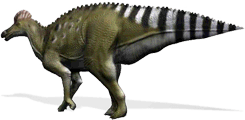
Pronunciation: MAG-nuh-POR-lee-uh
Meaning: Paul Haaga's large one
Author/s: Prieto-Márquez et al. (2012)
Synonyms: Lambeosaurus laticaudus
First Discovery: Baja California, Mexico
Acta Ordinal: #824
Magnapaulia laticaudus
Quickly scooting over the name, which roughly translates to "Paul Haaga's large one", Magnapaulia is the second lambeosaurine known from Mexico. However, it bears an uncanny resemblance to the first—the Cerro del Pueblo Formation's Velafrons coahuilensis—and many other lambeosaurines, for that matter, which was the cause of much confusion down the years.
The remains that would become Magnapaulia led William J. Morris a merry dance for almost a decade and a half. He initially assigned them to Hypacrosaurus altispinus based on the long neural spines on its tail vertebrae and the design of its hip, then referred them to cf. Lambeosaurus based on similarly long and narrow nostrils, and finally used its remains to erect an all-new species of Lambeosaurus: ?Lambeosaurus laticaudus. He prefixed the latter with a question mark because he still wasn't entirely sure of this assignment. But what he was convinced of, for a trio of reasons, is that his new ?Lambeosaurus was a sea-dweller.
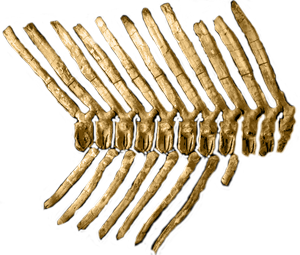 Morris assumed, firstly, its insanely deep tail, due to chevrons (underneath) and spines (on top) which were four times longer than the centra (the central part of the vertebra) to which they were attached, was a means to propel itself through the water. Secondly, he overestimated its size and assumed a 16.5-metre-long 8.5-ton animal was just too big to support its own weight on dry land. Finally, he pointed to a broken-but-healed thighbone, insisting that a crippled terrestrial dinosaur would've been a sitting duck, unable to survive long enough for its injury to heal. Like Cretaceous-aged seaways were any less perilous!
In 2012, Prieto-Márquez coined Magnapaulia and down-sized it to a slightly less spectacular 12.5 meters. But it's still one of the longest ornithischians, and the largest of the lambeosaurine hadrosaurs, judging by an 80+cm upper arm bone (LACM 17712). The sea-dwelling theory never really caught on.
The remains that would become Magnapaulia led William J. Morris a merry dance for almost a decade and a half. He initially assigned them to Hypacrosaurus altispinus based on the long neural spines on its tail vertebrae and the design of its hip, then referred them to cf. Lambeosaurus based on similarly long and narrow nostrils, and finally used its remains to erect an all-new species of Lambeosaurus: ?Lambeosaurus laticaudus. He prefixed the latter with a question mark because he still wasn't entirely sure of this assignment. But what he was convinced of, for a trio of reasons, is that his new ?Lambeosaurus was a sea-dweller.
Morris assumed, firstly, its insanely deep tail, due to chevrons (underneath) and spines (on top) which were four times longer than the centra (the central part of the vertebra) to which they were attached, was a means to propel itself through the water. Secondly, he overestimated its size and assumed a 16.5-metre-long 8.5-ton animal was just too big to support its own weight on dry land. Finally, he pointed to a broken-but-healed thighbone, insisting that a crippled terrestrial dinosaur would've been a sitting duck, unable to survive long enough for its injury to heal. Like Cretaceous-aged seaways were any less perilous!
In 2012, Prieto-Márquez coined Magnapaulia and down-sized it to a slightly less spectacular 12.5 meters. But it's still one of the longest ornithischians, and the largest of the lambeosaurine hadrosaurs, judging by an 80+cm upper arm bone (LACM 17712). The sea-dwelling theory never really caught on.
Etymology
Magnapaulia is derived from the Latin "magna" (large), referring to the unusually large size reached by at least some specimens, and "Paul" (for Mr. Paul Haaga), in honour of his outstanding support to the research and public programs of the Natural History Museum of Los Angeles County and its Dinosaur Institute.
The species epithet, laticaudus, is derived from the Latin "latus" (wide) and "cauda" (tail). ZooBank registry: urn:lsid:zoobank.org:act:FD9EDA56-7E2C-4F7D-A567-3BB1C4360C8E.
Discovery
The remains of Magnapaulia were discovered in the El Disecado Member of the El Gallo Formation, near the western coastline of the state of Baja California Norte, northwestern Mexico, at LACM locality 7253, no more than three miles west of the town of El Rosario by a team of the Natural History Museum of Los Angeles County between 1968 and 1974.
The holotype (LACM 17715) consists of skull fragments, a partial atlas (the first neck vertebra, which joins the skull to the spine), three partial and three nearly complete neck vertebrae, 10 back vertebrae in various states of completeness, a partial sacrum, fragmentary ribs and neural arches, partial right sternum, shoulder bones, right humerus, left hip bone (ischium), a complete left and partial right femur, a partial left shinbone, and a nearly complete left metatarsal III.
Prieto-Márquez et al. assigned a plethora of specimens to Magnapaulia in 2012, based on their close proximity and similarity to the holotype, including LACM 17712, the largest known specimen, which preserves scaly skin impressions.


