





Pronunciation: ah-MAHR-gah-SOR-us
Meaning: La Amarga lizard
Author/s: Salgado (1991)
Synonyms: None known
First Discovery: La Amarga, Argentina
Acta Ordinal: #362
Amargasaurus cazaui
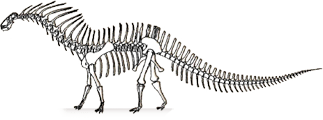
Amargasaurus is a dicraeosaurid, and like all dicraeosaurids, it was small, at least by sauropod standards. It had a disproportionately thick tail and a short neck that was beaten in shortness only by its close relative Brachytrachelopan. But its most notable feature is a twin row of long, upwards and backwards-directed, bowed spines that ran down its neck, become straighter and slightly shorter over its back, then merged into a single row towards its hip. .
Suggested reasons for such spines include ritual fancy-danning to attract a mate, a "my spines are bigger than yours" display to intimidate the competition, and supports for a heat-regulating skin sail or a camel-like hump. Each theory has been accepted and dismissed in equal measure over the years, and all seem plausible. But one expert reckons that the spines were sheathed in keratin (a naturally occurring protein that helps form such things as fingernails, hooves, and claws) and could be clanked together to ward off potential predators. If theropods are related to birds, why not a scarecrow-sauropod?
Perhaps by dipping the head, these appendages could be pulled into a more upright position when Amargasaurus were under attack to afford their neck — a hotspot for any self-respecting predator — an impressive and intimidating profile. Or maybe, given their rounded cross-section and pointed tips, these spines were a good old-fashioned self-defence mechanism that offered would-be diners a truly offensive mouthful: a bit like modern porcupines, but without the detachment.
Suggested reasons for such spines include ritual fancy-danning to attract a mate, a "my spines are bigger than yours" display to intimidate the competition, and supports for a heat-regulating skin sail or a camel-like hump. Each theory has been accepted and dismissed in equal measure over the years, and all seem plausible. But one expert reckons that the spines were sheathed in keratin (a naturally occurring protein that helps form such things as fingernails, hooves, and claws) and could be clanked together to ward off potential predators. If theropods are related to birds, why not a scarecrow-sauropod?
Perhaps by dipping the head, these appendages could be pulled into a more upright position when Amargasaurus were under attack to afford their neck — a hotspot for any self-respecting predator — an impressive and intimidating profile. Or maybe, given their rounded cross-section and pointed tips, these spines were a good old-fashioned self-defence mechanism that offered would-be diners a truly offensive mouthful: a bit like modern porcupines, but without the detachment.
Etymology
Amargasaurus was unearthed near the town of La Amarga in the La Amarga formation, but is specifically named after La Amarga Arroyo, the brook or creek alongside which the only known Amargasaurus remains were recovered. Sauros means Lizard in Greek and, funnily enough, "Amarga" means bitter in Spanish. It seems this was a very bitter area!The species epithet, cazaui, honors Dr. Luis B. Cazau of Y.P.F. Exploration who, in 1983, introduced the authors to the palaeontological wealth of the locality. ZooBank registry: urn:lsid:zoobank.org:act:E4F8A803-D256-4CBA-BD3B-0F2DBFEF61B2.
Discovery
The remains of Amargasaurus were discovered in the La Amarga Formation of Neuquen Province, northwestern Patagonia, Argentina.
The Holotype (MACN-N 15) consists of a partial skull, vertebrae, a shoulder bone, forelimb, hindlimb, part of a hip, and an ankle bone.


