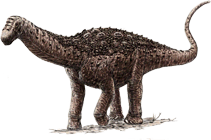
Pronunciation: SOH-ro-POD-uh-MOR-fuh
Author: von Huene
Year: 1932
Meaning: Lizard-feet forms (see etymology)
Locomotion: Bi and quadrupedal (two and/or four legs)
Synonyms: Pachypodosauria (Huene, 1914),
Brontosauria (Olshevsky, 1991)
Brontosauria (Olshevsky, 1991)
[Sereno, 2005]Definition
The most inclusive clade containing Saltasaurus loricatus but not Passer domesticus and Triceratops horridus.
About
Sauropodomorpha appears in the Late Triassic as one of the two major branches of Saurischia, peeling away from its early predatory relatives to pursue a radically different future. Their earliest representatives are small, quick-stepping omnivores with lengthening necks and swelling abdominal cavities, creatures taking the first steps of an herbivorous experiment that will one day reshape entire ecosystems.
Gradually, these early sauropodomorphs — the so-called "prosauropods" — spread across Pangaea, steadily increasing body size, leaning harder into plant-eating, and beginning to flirt with quadrupedality. By the dawn of the Jurassic, the blueprint is unmistakable: long necks for reach, deep torsos for fermentation, limbs edging toward the columns they will eventually become. These early steps are the prologue to gigantism — the quiet overture before the thunder of true sauropods.
Sauropodomorpha's defining character is its commitment to scale — anatomical, ecological, and evolutionary. The earliest forms are small, agile, and still carry grasping hands and flexible forelimbs, but as the lineage matures, the body plan shifts with deliberate momentum toward weight-bearing architecture. Necks lengthen into sweeping arcs; vertebrae begin to hollow under the first incursions of air; limbs stiffen, straighten, and brace for the mass to come. The entire clade becomes a negotiation between mobility and mass, flexibility and structural reinforcement — a slow, sustained dialogue with gravity itself.
Sauropodomorphs reach their first major peak in the Early Jurassic, dominating herbivore guilds across much of the world. As true sauropods rise to prominence, the more basal forms fade, with most disappearing by the Middle Jurassic, yet their legacy is profound. They are the innovators, the adapters, the architects of the sauropod body plan, and the evolutionary bridge between nimble, omnivorous, bipedal ancestors and the largest terrestrial animals in Earth's history.
Click here to search Dinochecker for sauropodomorphs.
Etymology
Sauropodomorpha is derived from the Greek "sauros" (lizard), "pod" (feet) and "morpha" (forms).
Relationships
References
• von Huene F (1932) "The fossil reptile order Saurischia, their
development and history". Monographs of Geological and Palaeontology, 1(4): 12361.
• Tidwell V and Carpenter K (2005) "Thunder-Lizards: The Sauropodomorph Dinosaurs".
• Otero A, Krupandan E, Pol D, Chinsamy A and Choinier J (2015) "A new basal sauropodiform from South Africa and the phylogenetic relationships of basal sauropodomorphs". Zoological Journal of the Linnean Society, 174(3): 589-634. DOI: 10.1111/zoj.12247.
• Molina-Pérez R and Larramendi A (2020) "Dinosaur Facts and Figures: The Sauropods and Other Sauropodomorphs".
• Otero A, Carballido JL and Pol D (2022) "South American Sauropodomorph Dinosaurs: Record, Diversity and Evolution".
• Müller RT and Garcia MS (2020) "Rise of an empire: analyzing the high diversity of the earliest sauropodomorph dinosaurs through distinct hypotheses". Historical Biology, 32(10): 1334-1339. DOI: 10.1080/08912963.2019.1587754.
• Pol D, Otero A, Apaldetti C and Martínez RN (2021) "Triassic sauropodomorph dinosaurs from South America: The origin and diversification of dinosaur dominated herbivorous faunas". Journal of South American Earth Sciences, 107: 103145. DOI :10.1016/j.jsames.2020.103145.
• Lefebvre R, Houssaye A, Mallison H, Cornette R and Allain R (2022) "A path to gigantism: Three-dimensional study of the sauropodomorph limb long bone shape variation in the context of the emergence of the sauropod bauplan". Journal of Anatomy, 241(2): 297-336. DOI: 10.1111/joa.13646
• Botha J, Choiniere JN and Benson RBJ (2022) "Rapid growth preceded gigantism in sauropodomorph evolution". Current Biology (advance online publication).
DOI: 10.1016/j.cub.2022.08.031.
• Otero A, Carballido JL and Pol D (2022) "South American Sauropodomorph Dinosaurs: Record, Diversity and Evolution".