Pronunciation: SOR-uh-POD-ih-FOR-meez
Author: Sereno
Year: 2007
Meaning: In the form of sauropods (see etymology)
Locomotion: Bi and quadrupedal (2 and 4 legs)
Synonyms: None known
[McPhee et al., 2014]Definition
All sauropodomorphs more closely related to Saltasaurus loricatus than to Massospondylus carinatus.
About
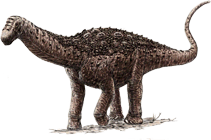
Sauropodiformes rose within Massopoda as the lineage that carried sauropodomorph evolution beyond its early experimental phase. Defined as all sauropodomorphs closer to Saltasaurus than to Massospondylus, it captures the interval when lineages begin to shed the mixed-posture versatility of their ancestors and commit to something far more ambitious. These dinosaurs appear during a period of diversification that spans the end-Triassic turnover, and they seize the moment with a new evolutionary wager: growth as strategy, mass as trajectory. Their anatomy reveals a lineage no longer sampling possibilities, but converging — steadily, repeatedly — on the traits that will define the first true giants.
Sauropodiformes is where the sauropod silhouette becomes unmistakable. Their necks lengthen into sweeping arcs; vertebrae stretch into long, weight-efficient beams; the forelimbs strengthen relative to the hindlimbs; the hands stiffen as they transition toward bulk-bearing roles. The torso deepens, the pelvis broadens, and the tail becomes a more substantial counterbalance. Their skulls simplify into efficient cropping tools, their teeth become more uniform, and their digestive systems expand to handle increasingly fibrous diets. They can still rear bipedally, but their centre of mass is migrating forward, and quadrupedalism is becoming the prevailing mode. Ecologically, they begin to function as large-bodied herbivores capable of sustained bulk-feeding, opening the path toward megaherbivory.
Sauropodiformes is the threshold — the final approach to Sauropoda. It is the stage where the lineage's evolutionary direction becomes unmistakable: locomotion reorganised around stability, feeding around throughput, and life history around the economics of scale. Sauropods do not erupt suddenly from the fossil record; they emerge from this long, disciplined tightening of form and function. Sauropodiformes provides the continuity — the bridge between robust early herbivores and the column-limbed titans that would dominate the Jurassic. Their legacy is the decision to pursue growth as far as biology will allow, the evolutionary commitment that made the largest land animals in Earth's history not only possible, but inevitable.
Click here to view Dinochecker's A-Z list of Sauropodiformes
Etymology
Sauropodiformes is derived from the Greek "sauros" (lizard) and "pod" (foot), and the Latin "formes" (form, shape), named for a group of animals that approach the sauropod body plan.
Relationships
References
• Sereno PC (2007) "Basal Sauropodomorpha: historical and recent phylogenetic hypotheses, with comments on Ammosaurus major (Marsh, 1889). Evolution and Palaeobiology of Early Sauropodomorph Dinosaurs". Special Papers in Palaeontology, 77: 261–299.
• McPhee BW, Yates AM, Choiniere JN and Abdala F (2014) "The complete anatomy and phylogenetic relationships of Antetonitrus ingenipes (Sauropodiformes, Dinosauria): implications for the origins of Sauropoda". Zoological Journal of the Linnean Society, 171(1): 151-205.