









Pronunciation: ywen-YAHNG-long
Meaning: Lovebird Dragon
Author/s: Hao et al. (2024)
Synonyms: None known
First Discovery: Chilantai, China
Acta Ordinal: #1186
Yuanyanglong bainian
(100 Year Lovebird Dragon)Etymology
Yuanyanglong is derived from the Mandarin "Yuanyang" (lovebirds) and "long" (dragon). To westerners, the Lovebird is the common name of Agapornis, a group of parrots with a strong inclination to form lifelong bonds with their mates. However, in this case it refers to Aix galericulata, commonly known as "the Mandarin Duck", which are also believed to mate for life, just as two specimens of Yuanyanglong were bonded in the same block. The species epithet, bainian (bye-nyen), means "a hundred years" in Chinese, in commemoration of the 100th anniversary of the first named oviraptorosaurs, Chirostenotes and Oviraptor, in March 1924 and November 1924, respectively. ZooBank registry: urn:lsid:zoobank.org:pub:C1902E2A-4BCD-426D-8054-745B06FDE556.
Discovery
The remains of Yuanyanglong were discovered in the Miaogou Formation at the Maortu locality, Chilantai, western Inner Mongolia, China., during an expedition in the summer of 2021.
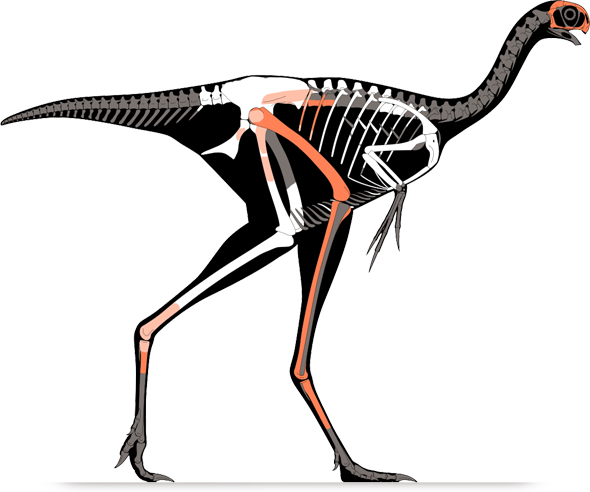
The holotype (PV 02476-1) includes the pelvic and shoulder girdles, a right hindlimb missing the foot, the right forelimb missing the hand, several ribs, and vertebrae from the back and tail. A referred specimen (PV 02476-2) includes an incomplete poorly-preserved skull, a partial hindlimb without the foot, incomplete pelvis, several back vertebrae, and a partial block of hip vertebrae. Both specimens were closely preserved in the same block.
Preparators
Lishi Xiang and Chunjun Zeng.


