









Pronunciation: BEK-el-SPIEN-aks
Meaning: Beckle's Spined one
Author/s: Olshevsky (1991)
Synonyms: See below
First Discovery: East Sussex, England
Acta Ordinal: #365
Becklespinax altispinax
If ever a dinosaur has caused headaches, hysteria, hernias, and hand-bag-throwing in equal measure, what we now know as Becklespinax is it! The problems stem from a single tooth from Hanover, Germany, that Wilhelm Barnim Dames had named Megalosaurus dunkeri in 1884, and were compounded by Richard Lydekker who saw fit to refer almost the entire collection of British Museum Wealden theropod remains to it four years later|1|, before removing a few foot bones (BMNH R2559) and naming them Megalosaurus oweni.
Unfortunately, Friedrich von Huene seldom shied away when the opportunity to wallow in Megalosaurus muck presented itself, and in 1923 he recombined both species of Megalosaurus as Altispinax — the "high-spined one" — for a block of three high-spined vertebrae (BMNH R1828) that were mingled with the above-mentioned remains, though he didn't tie the bones to the name by declaring them holotype, or even provide a species epithet, which was always going to cause problems somewhere down the line.
In 1937, Oscar Kuhn could've brought order from chaos when he revisited Altispinax, but with BMNH R1828 staring him right in the face he nominated Dames' tooth as name-bearer|2|, meaning tooth and name were now inseparable. When the tooth was later outed as non-diagnostic and thus dubious, the high spines of the "high-spined one" were in need of a new name, and after a stint as Greg Paul's Acrocanthosaurus altispinax, a second species of Acrocanthasaurus that was no such thing, George Olshevsky nabbed them and coined Becklespinax in honour of discoverer Samuel Husbands Beckles in 1991|3|. At the same time, BMNH R2559 (previously Megalosaurus oweni) was renamed Valdoraptor.
Although lumped with Megalosaurus dunkeri by Lydekker in 1884, the remains of Becklespinax were initially figured in 1855 by Richard Owen who assigned them to Megalosaurus bucklandi in 1856|4|, and there's no doubt he had these remains in hand when he designed the hunchbacked Megalosaurus that still stands proudly at Crystal Palace, London. However, the spines seem to belong over its hips, much like those of the later-named Concavenator from Cuenca, Spain, rather than over its shoulders, and they were the first Mesozoic dinosaurian remains to be mentioned in the same breath as pneumaticity|5| (cavities in the bone, linked to the respiratory system, as seen in modern birds) when Owen waxed lyrical about "three deep depressions, probably receiving parts of the lungs in the living animal" in 1856.
Unfortunately, Friedrich von Huene seldom shied away when the opportunity to wallow in Megalosaurus muck presented itself, and in 1923 he recombined both species of Megalosaurus as Altispinax — the "high-spined one" — for a block of three high-spined vertebrae (BMNH R1828) that were mingled with the above-mentioned remains, though he didn't tie the bones to the name by declaring them holotype, or even provide a species epithet, which was always going to cause problems somewhere down the line.
In 1937, Oscar Kuhn could've brought order from chaos when he revisited Altispinax, but with BMNH R1828 staring him right in the face he nominated Dames' tooth as name-bearer|2|, meaning tooth and name were now inseparable. When the tooth was later outed as non-diagnostic and thus dubious, the high spines of the "high-spined one" were in need of a new name, and after a stint as Greg Paul's Acrocanthosaurus altispinax, a second species of Acrocanthasaurus that was no such thing, George Olshevsky nabbed them and coined Becklespinax in honour of discoverer Samuel Husbands Beckles in 1991|3|. At the same time, BMNH R2559 (previously Megalosaurus oweni) was renamed Valdoraptor.
Although lumped with Megalosaurus dunkeri by Lydekker in 1884, the remains of Becklespinax were initially figured in 1855 by Richard Owen who assigned them to Megalosaurus bucklandi in 1856|4|, and there's no doubt he had these remains in hand when he designed the hunchbacked Megalosaurus that still stands proudly at Crystal Palace, London. However, the spines seem to belong over its hips, much like those of the later-named Concavenator from Cuenca, Spain, rather than over its shoulders, and they were the first Mesozoic dinosaurian remains to be mentioned in the same breath as pneumaticity|5| (cavities in the bone, linked to the respiratory system, as seen in modern birds) when Owen waxed lyrical about "three deep depressions, probably receiving parts of the lungs in the living animal" in 1856.
(Beckles' spined one)Etymology
Becklespinax is derived from "Beckles" (in honor of Samuel Husband Beckles, esq. who made the original discovery) and the Latin "spinax" (a reference to its spined vertebrae). The species epithet (or specific name), altispinax, is a reference to its previous genus name, Altispinax, which means "high-spined" in Latin.
Discovery
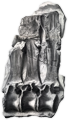
The only remains of Becklespinax were discovered in the Hastings Beds of the Wealden group, Battle, East Sussex, in the 1850's by Samuel Husband Beckles. The holotype (BMNH R1828), originally assigned to Megalosaurus... then Altispinax... then Acrocanthosaurus, is a series of three oh-so-distinct high-spined vertebrae.


