




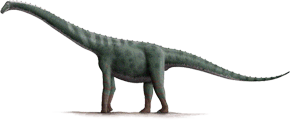
Pronunciation: RIN-con-SOR-us
Meaning: Rincón de los Sauces lizard
Author/s: Calvo and Riga (2003)
Synonyms: None known
First Discovery: Neuquén, Argentina
Acta Ordinal: #534
Rinconsaurus caudamirus
Although known from the remains of at least four individuals, Rinconsaurus is riddled with uncertainty. Its place of discovery was originally listed as the "Río Neuquén Formation", which was later reclassified as the Río Neuquén Subgroup, but no one was sure which of its five formations had actually yielded the bones. Its total length—often guestimated at around eleven metres—remains unknown because nothing close to a complete neck has ever been recovered. And on top of that, palaeontologists still can't agree on whether it truly belongs to Aeolosaurini—a Casal-proposed clade of titanosaurs that also includes Gondwanatitan and Aeolosaurus—or where that group belongs on the titanosaur tree.
In 2015, Filippi finally clarified its provenance, assigning Rinconsaurus to the slightly younger Bajo de la Carpa Formation of the entirely different Río Colorado Subgroup. But everything else, apart from the reidentification of two supposed paratype skull fragments as a crocodile hip bone and a piece of its own rib, remains as uncertain as it was.
Based on the design of its vertebrae, Rinconsaurus is a shoo-in titanosaur—the sauropod lineage known as the "giant lizards", which are renowned for being robust but not necessarily giant-sized. Ironically, Rinconsaurus isn't robust either. Like Muyelensaurus, it was an unusually slender member of the family, which is surprising given that titanosaurs weren't particularly fussy eaters and would happily chomp their way through everything from cycads and conifers to the ancestors of rice plants and bamboo, as confirmed by studies of their fossilized dung.
In 2015, Filippi finally clarified its provenance, assigning Rinconsaurus to the slightly younger Bajo de la Carpa Formation of the entirely different Río Colorado Subgroup. But everything else, apart from the reidentification of two supposed paratype skull fragments as a crocodile hip bone and a piece of its own rib, remains as uncertain as it was.
Based on the design of its vertebrae, Rinconsaurus is a shoo-in titanosaur—the sauropod lineage known as the "giant lizards", which are renowned for being robust but not necessarily giant-sized. Ironically, Rinconsaurus isn't robust either. Like Muyelensaurus, it was an unusually slender member of the family, which is surprising given that titanosaurs weren't particularly fussy eaters and would happily chomp their way through everything from cycads and conifers to the ancestors of rice plants and bamboo, as confirmed by studies of their fossilized dung.
(Rincon lizard with an amazing tail)Etymology
Rinconsaurus is derived from "Rincón de los Sauces" (the area where its fossils were discovered) and the Greek "sauros" (lizard).
The species epithet, caudamirus, is derived from the Latin "cauda" (tail) and "mirus" (amazing, wonderful, marvellous), in reference to the unusual shape of its tail vertebrae.
Discovery
The remains of Rinconsaurus were discovered in 1997 by Gabriel Benítez at Cañadón Río Seco, 2 km north of Rincon de los Sauces, in what was originally listed as the "Río Neuquén Formation". They were extracted by Jorge Calvo and his team from the Paleontology Museum of the National University of Comahue. However, the "Río Neuquén Formation" is now the Río Neuquén subgroup of the Neuquén group, and after being briefly assigned to the Anacleto Formation by Garrido, Fillipi announced in 2015 that Rinconsaurus is actually from the somewhat older Bajo de la Carpa Formation, which was previously known as the Bajo de la Carpa member. The holotype (MRS-Pv 26) is a series of 13 tail vertebrae and two ilia (hip bones).


