




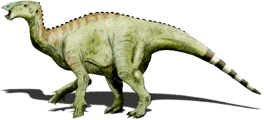
Pronunciation: HIP-sel-o-SPIEN-us
Meaning: Tall spined
Author/s: Norman (2010)
Synonyms: See below
First Discovery: East Sussex, England
Acta Ordinal: #716
Hypselospinus fittoni
Iguanodon fittoni was coined by Richard Lydekker in 1889 for remains from the Wadhurst Clay Formation of East Sussex, England, but it's validity was called into doubt after Belgium's Iguanodon bernissartensis ousted Iguanodon anglicus as the official Iguanodon mascot and name-bearer in 2000.
Soon after, it became apparent that many so-called Iguanodon species actually belonged elsewhere instead, and as part of the ensuing clean-up job this gracile styracosternan and the name-prompting long, narrow, and steeply inclined spines protruding from its vertebrae were renamed Hypselospinus by David Norman in 2010.
Hypselospinus shared its time and place with the much more robust Iguanodon dawsoni which, as it turns out, wasn't much Iguanodon-like either. Nor was it like Hypselospinus, so its "heavy ilium" and large Camptosaurus-like vertebrae with short spines were also Norman-ised and given their own name, Barilium, in 2010.
In a bizarre turn of events, a second team of scientists managed to study these same remains during the same year without getting wind of Norman's work and renamed Iguanodon fittoni and Iguanodon dawsoni themselves. Unfortunately, they were a little too late to the printers, so their "Wadhurstia" and "Torilion" were immediately chalked off as junior synonyms of Hypselospinus and Barilium respectively.
Soon after, it became apparent that many so-called Iguanodon species actually belonged elsewhere instead, and as part of the ensuing clean-up job this gracile styracosternan and the name-prompting long, narrow, and steeply inclined spines protruding from its vertebrae were renamed Hypselospinus by David Norman in 2010.
Hypselospinus shared its time and place with the much more robust Iguanodon dawsoni which, as it turns out, wasn't much Iguanodon-like either. Nor was it like Hypselospinus, so its "heavy ilium" and large Camptosaurus-like vertebrae with short spines were also Norman-ised and given their own name, Barilium, in 2010.
In a bizarre turn of events, a second team of scientists managed to study these same remains during the same year without getting wind of Norman's work and renamed Iguanodon fittoni and Iguanodon dawsoni themselves. Unfortunately, they were a little too late to the printers, so their "Wadhurstia" and "Torilion" were immediately chalked off as junior synonyms of Hypselospinus and Barilium respectively.
(Fittoni's tall-spined one)Etymology
Hypselospinus is derived the Greek "hypselos" (high, tall) and the Latin "spina" (thorn), which refers to its high spines.
The species epithet, fittoni, honors Irish geologist William Henry Fitton.
Discovery
The remains of Hypselospinus were discovered in the Wadhurst Clay of East Sussex, England, in 1886. The holotype (BMNH R1635) includes a left ilium, a sacrum, tail vertebrae and teeth.
Synonyms
Iguanodon Fittoni (Lydekker, 1889)Wadhurstia (Carpenter and Ishida, 2010)


