




Pronunciation: sal-TEE-yo-MIEM-us
Meaning: Saltillo mimic
Author/s: Aguillón Martínez (2010)
Synonyms: None known
First Discovery: Coahuila, Mexico
Acta Ordinal: #
Saltillomimus rapidus
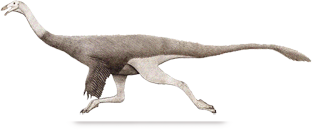
"Saltillomimus" was heralded as the first articulated—joined-at-the-joints—theropod to be found in Mexico, but the articulation was severely limited by the fact that its remains belong to three separate specimens from three different quarries, and they don't amount to much. A few hind leg bones, a finger or two, a couple of hip bones and maybe a tail vertebra represent the entirety of its fossils. But the biggest issue is that it was named and barely described in the 2010 thesis of Martha Carolina Aguillón Martínez which is hidden behind a paywall, and it would not be an accepted scientific platform even if she had included locality data and much of what is required to validate newly-named critters, which she hadn't.
Regardless, a skeletal reconstruction was put on display to much fanfare in 2014 at Museo del Desierto where Aguillón Martínez is resident vertebrate palaeontologist, which served to highlight its robust thighs and weird hips that combine primitive and advanced features seen in ornithomimosaurs from both Asia and North America. Unfortunately, "Saltillomimus" continues to dodge peer-review and ignore protocol, and so the name is enclosed in "quotes" to denote its unofficial status.
Regardless, a skeletal reconstruction was put on display to much fanfare in 2014 at Museo del Desierto where Aguillón Martínez is resident vertebrate palaeontologist, which served to highlight its robust thighs and weird hips that combine primitive and advanced features seen in ornithomimosaurs from both Asia and North America. Unfortunately, "Saltillomimus" continues to dodge peer-review and ignore protocol, and so the name is enclosed in "quotes" to denote its unofficial status.
(Fast Saltillo mimic)Etymology
"Saltillomimus" is derived from "Saltillo" (its place of discovery) and the Latin "mimos" (mimic), in reference as its placement as an ornithomimosaur ("bird mimic lizard").
The species epithet, rapidus, means "fast" in Latin.
After Velafrons Coahuilensis, Muzquizopteryx coahuilensis, and Coahuilceratops Magnacuerna, "Saltillomimus rapidus" is the fourth critter that Coahuila has contributed to the fossil register, but it's the only one that doesn't honour the state in its name.
Discovery
The first remains of "Saltillomimus" were discovered in the Cerro del Pueblo Formation (Difunta Group) at La Majada, Saltillo, Coahuila State, Mexico, by Martha Carolina Aguillón Martínez in 1998.
The holotype (SEPCP 16/237) includes hip bones, a partial right leg and some hand bones. A smaller, possibly juvenile specimen (SEPCP 16/221, including a partial left leg and a hip bone) were found nearby. A tail vertebra from Ramos Arizpe that was previously described as Ornithomimus sp. may belong to "Saltillomimus".


