









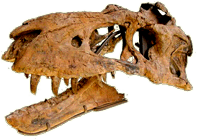
Pronunciation: bis-tah-he-ee-VER-sor
Meaning: Bistahi destroyer
Author/s: Carr and Williamson (2010)
Synonyms: Non known
First Discovery: Bisti, New Mexico
Acta Ordinal: #732
Bistahieversor sealeyi
Originally, the "Bisti Beast" from the badlands of northwestern New Mexico was thought to be a specimen of Albertosaurus, then Aublysodon mirandus, then Daspletosaurus, based on a partial skull and skeleton found by J.W Stovall and D.E. Savage way back in 1940. However, the 2010 restudy of several more skulls and other bits and bobs from the same area convinced Thomas's Carr and Williamson that Mexico now had their very own and all new tyrannosaurid, albeit a very primitive one, despite them sniggering at Lehman and Carpenter when they suggested the very same thing in 1990.
Bistahieversor sealeyi has several snazzy features that experts are still studiously pondering over, such as a mysterious hole above its eyes and a jaw "locking" mechanism similar to its Asian relative - Tarbosaurus bataar. With much of its internal workings hidden from view and likely to stay that way for fear of irreparable damage, many questions regarding skull anatomy remained unanswered, though Bistahieversor, Teratophoneus before it and Lythronax before that, were clearly signposts on the road to tyrant lizard deep-snouted-ness that culminated in Tyrannosaurus rex.
In 2017, scientists performed the highest-ever-resolution scan of a tyrannosaur skull to extract previously inaccesible information by blasting the holotype of Bistahieversor with proton beams from the the Mark-IV LANSCE electron accelerator, and used newly developed neutron imaging technology to peek at the skull's brain cavity, internal bone structure, sinus cavities, pathways of some nerves and blood vessels, and other anatomical structures. The results have yet to be published.
Bistahieversor sealeyi has several snazzy features that experts are still studiously pondering over, such as a mysterious hole above its eyes and a jaw "locking" mechanism similar to its Asian relative - Tarbosaurus bataar. With much of its internal workings hidden from view and likely to stay that way for fear of irreparable damage, many questions regarding skull anatomy remained unanswered, though Bistahieversor, Teratophoneus before it and Lythronax before that, were clearly signposts on the road to tyrant lizard deep-snouted-ness that culminated in Tyrannosaurus rex.
In 2017, scientists performed the highest-ever-resolution scan of a tyrannosaur skull to extract previously inaccesible information by blasting the holotype of Bistahieversor with proton beams from the the Mark-IV LANSCE electron accelerator, and used newly developed neutron imaging technology to peek at the skull's brain cavity, internal bone structure, sinus cavities, pathways of some nerves and blood vessels, and other anatomical structures. The results have yet to be published.
(Seeley's Bistahi destroyer)Etymology
Bistahieversor combines the Navajo "Bistahi" (for the Bisti Wilderness Area) and the Greek "eversor" (destroyer), in reference to its predatory habits.The species epithet, sealeyi (SEE-lee-eye), honors Paul Sealey, research associate at the NMMNH, in recognition of his discovery of the holotype.
Discovery
The first remains of Bistahieversor were recovered from locality L-3506 in the Hunter Wash Member of the Kirtland Formation, Bisti/De-na-zin Wilderness Area, northwestern New Mexico, USA, by Paul Sealey in 1996. The Hunter Wash has been dated to 74-72 mya, meaning Bistahieversor was the dominant predator in the southwestern United States at the same time as Albertosaurus and Daspletosaurus were bossing the North.
The Holotype (NMMNH P-27469) is the partial skeleton and articulated skull (1070 mm long) of a sub adult. An incomplete juvenile skull and skeleton (NMMNH P-25049), a snout bone (NMMNH P-32824), and a partial adult skull and skeleton (OMNH 10131) from the Kirtland Formation's Farmington member and the Fruitland Formation's Hunter Wash and Ah-shi-sle-pah Wash respectively, have also been assigned to Bistahieversor.


