









Pronunciation: al-BUHR-tuh-DRO-mee-us
Meaning: Alberta runner
Author/s: C.M Brown et al. (2013)
Synonyms: None known
First Discovery: Alberta, Canada
Acta Ordinal: #859
Albertadromeus syntarsus
Just as "raptor" (plunderer) became a pet suffix of paleontologists when naming small carnivorous dinosaurs with sickle-shaped claws on the second toes of their hind feet, so "dromeus" (runner) has come to be associated with dinosaurs that are built for running. By 2013 there were an equal number of carnivorous and herbivorous dinoaurs suffixed with dromeus, and the ratio didn't change when the slightly derived Dromaeosaurus and Pampadromaeus were taken into account, so Albertadromeus—all of a meter and a half long and 15kg on a good day—held the balance-tipping power in its diddy, possibly five-fingered hands. 4-3 to the vegetarians. Boo.
Albertadromeus is a member of Orodrominae, a family of small bipedal ornithopods who, by association with what appear to be underground lairs, have been tagged "burrowers", even though they seem ill-equipped for digging. What Albertadromeus is well equipped to do, however, is run (hence the name) due to its ankle bones being fused which is thought to be an adaptation for speed and agility. And being pretty much at the bottom of the food chain in its eco-system it had a lot of running to do.
At around the size of a turkey, Albertadromeus is the smallest herbivorous dinosaur known from Canada. In fact, because small dinosaurs are more prone to being chewed to nothing by larger hunters, or destroyed by the elements or scavenging predators before they have a chance to fossilise, it's one of the few small dinosaurs of any kind known from Canada.
Albertadromeus is a member of Orodrominae, a family of small bipedal ornithopods who, by association with what appear to be underground lairs, have been tagged "burrowers", even though they seem ill-equipped for digging. What Albertadromeus is well equipped to do, however, is run (hence the name) due to its ankle bones being fused which is thought to be an adaptation for speed and agility. And being pretty much at the bottom of the food chain in its eco-system it had a lot of running to do.
At around the size of a turkey, Albertadromeus is the smallest herbivorous dinosaur known from Canada. In fact, because small dinosaurs are more prone to being chewed to nothing by larger hunters, or destroyed by the elements or scavenging predators before they have a chance to fossilise, it's one of the few small dinosaurs of any kind known from Canada.
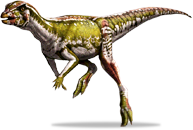
(Alberta runner with a fused ankle)Etymology
Albertadromeus is derived from "Alberta" (the Canadian Province) in reference to the place of its first discovery, and
the Greek "dromeus" (runner) because of the animal's presumed cursorial (running) nature.
The species epithet (or specific name), syntarsus, is derived from the greek "Syn" (together) and "tarsus" (ankle), meaning its tibia (shin) and fibula (calf) were fused together at the point where they join the ankle.
Discovery
The remains of Albertadromeus were discovered in the Upper Oldman Formation at Canal Creek (between the Comrey Sandstone and McPheeter's Bonebed) in the northern section of the Pinhorn Provincial Grazing Reserve, Alberta, Canada, by Dr. David Evans in 2009.
The holotype (TMP 2009.037.0044) is a partial skeleton including a neck "rib", two dorsal (back) vertebrae, one caudal (tail) vertebra, tendons, left tibia and fibula and a fragment of right fibula (shin bones), and fragmentary foot material.


