


Pronunciation: THES-kel-o-SOR-uh-day
Author: Charles M. Sternberg
Year: 1937
Meaning: Wondrous lizards (see etymology)
Locomotion: Bipedal (2 legs)
Synonyms:
Parksosauridae (Buchholtz, 2002)
Jeholosauridae? (Han et al., 2012)
Author: Charles M. Sternberg
Year: 1937
Meaning: Wondrous lizards (see etymology)
Locomotion: Bipedal (2 legs)
Synonyms:
Parksosauridae (Buchholtz, 2002)
Jeholosauridae? (Han et al., 2012)
[Brown et al. 2013]Definition
Thescelosaurus neglectus, Orodromeus makelai, their most recent common ancestor, and all descendants.
About
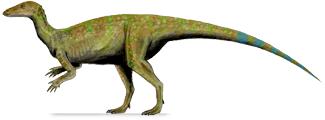
Thescelosauridae was a diverse radiation of small to medium-sized herbivores that flourished throughout the Cretaceous. Descending from early neornithischian ancestors before the rise of true ornithopods, thescelosaurids followed an evolutionary path distinct from the lineage that would eventually produce iguanodontians and hadrosaurids. Fossils are known from North America, Asia, and South America, suggesting that the group achieved a broad geographic distribution despite retaining relatively modest body sizes. Their early record remains patchy, but by the Early Cretaceous they had become an established component of terrestrial ecosystems.
Thescelosaurids are characterized by broad, expanded shoulder blades, powerful limbs, and fused premaxillae reinforcing the snout tip, all of which may have aided in shovelling muck. Evidence from across the clade suggests that burrowing behaviour may have been widespread among thescelosaurids, with the clearest evidence coming from the orodromine Oryctodromeus, whose skeletons were discovered within fossil burrows. Ecologically, thescelosaurids occupied a very different niche from the larger herbivores that shared their environments. Their relatively small skulls, weaker dentition, and less powerful jaw musculature indicate highly selective feeding habits. Rather than cropping and grinding large quantities of coarse vegetation, thescelosaurids likely focused on soft, pulpy foods requiring little oral processing, perhaps using their long, low snouts to probe shrubs and low vegetation for delicate fruits, shoots, and other nutrient-rich, high quality fodder.
Thescelosaurids persisted for tens of millions of years alongside increasingly specialized herbivorous dinosaurs, surviving even as hadrosaurids and ceratopsians came to dominate many Late Cretaceous ecosystems. Although they never achieved the enormous size or ecological prominence of those groups, they were remarkably successful in their own right, persisting until the end of the Cretaceous extinction event, while avoiding direct competition with the giant plant-eaters that increasingly dominated Mesozoic landscapes.
Click here to search the database for thescelosaurids.
Etymology
Thescelosauridae is derived from the Greek "theskelos" (wonderful, surprising) and "sauros" (lizard), and the Latin "idae" (family).
Relationships
References
• Sternberg CM (1937) "Classification of Thescelosaurus, with a description of a new species". Proceedings of the Geological Society of America, 1936: 375.
• Sues H-D and Norman DB (1990) "Hypsilophodontidae, Tenontosaurus, Dryosauridae". In Weishampel, Dodson and Osmólska (eds.) "The Dinosauria: First Edition".
• Norman DB, Sues H-D, Witmer LM and Coria RA (2004) "Basal Ornithopoda". In Weishampel, Dodson and Osmólska (eds.) "The Dinosauria: Second Edition".
• Varricchio DJ, Martin AJ and Katsura Y (2007) "First trace and body fossil evidence of a burrowing, denning dinosaur". Proceedings of the Royal Society B: Biological Sciences, 274 (1616): 1361–1368. DOI: 10.1098/rspb.2006.0443.
• Holtz jr TR (2008) "The Most Complete, Up-to-Date Encyclopedia for Dinosaur Lovers of All Ages".
• Brown CM, Evans DC, Ryan MJ and Russell AP (2013) "New data on the diversity and abundance of small-bodied ornithopods (Dinosauria, Ornithischia) from the Belly River Group (Campanian) of Alberta". Journal of Vertebrate Paleontology, 33(3): 495-520.
DOI: 10.1080/02724634.2013.746229.
• Madzia D, Arbour VM, Boyd CA, Farke AA, Cruzado-Caballero P and Evans DC (2021) "The phylogenetic nomenclature of ornithischian dinosaurs". PeerJ, 9: e12362. DOI: 10.7717/peerj.12362.
• Wyenberg-Henzler T, Patterson RT and Mallon JC (2022) "Size-mediated competition and community structure in a Late Cretaceous herbivorous dinosaur assemblage". Historical Biology, 34(11): 2230-2240. DOI: 10.1080/08912963.2021.2010191.
• Button DJ and Zanno LE (2023) "Neuroanatomy of the late Cretaceous Thescelosaurus neglectus (Neornithischia: Thescelosauridae) reveals novel ecological specialisations within Dinosauria". Scientific Reports, 13(1): 19224. DOI: 10.1038/s41598-023-45658-3.
•
Holtz TR (2026) "Thescelosauridae and Ornithopoda: Beaks, bills and crests". GEOL 104: Dinosaurs — A Natural History. University of Maryland.


