THECOCOELURUS
a problematic theropod dinosaur from the Early Cretaceous of the Isle of Wight.
Pronunciation: THEE-ko-see-LOO-rus
Meaning: Sheathed hollow tail
Author/s: Huene (
1923)
Synonyms: See
below
First Discovery: Isle of Wight, England
Acta Ordinal: #141
Thecocoelurus daviesi
Discovered by the Reverend William Fox on the Isle of Wight during the late 19th century, the scant remains that would become Thecocoelurus were clocked by William Davies in the British Museum of Natural History after they acquired the last of Fox's fossil collection upon his death. Davies thought it was a critter similar to Coelurus, but Harry Seeley chose instead to place it within Thecospondylus, which he had named himself in 1882 based on a sacrum from the "Hasting Sand", but as a second species—Thecospondylus Daviesi—honouring Davies, in 1888.
Nopcsa agreed with Davies and reassigned the specimen to Coelurus as Coelurus daviesi in 1901, then twenty-two years passed before Friedrich von Huene split the difference: deciding it was neither Thecospondylus nor Coelurus, he fused both names into Thecoelurus—a hybrid that literally means "sheathed hollow tail"... despite the fact that the holotype preserves neither a sheath nor a tail. And from there, things got really messy.
(Sheathed Hollow Tail)Etymology
Thecocoelurus is a contraction of "Thecospondylus" and "Coelurus"—derived from the Greek "theke" (sheath, socket), and the Greek koilos (hollow) and "oura" (tail)—referring to the two critters to which it was previously assigned, by Seeley in 1888, and Nopcsa in 1901.
The
species epithet,
daviesi, honours William Davies, who was the first to notice the specimen in the British Museum of Natural History after they acquired the collection of Reverend Fox (known as the "Fox collection") and assume a close affinity with
Coelurus.
Thecospondylus daviesi (Seeley, 1888)
Coelurus daviesi (Nopcsa, 1901)
Valdoraptor oweni? (Olshevsky, 1991)
Discovery
The remains of
Thecocoelurus were discovered in the Wessex Formation at Brook on the Isle of Wight, England, by Reverend William Fox in the late nineteenth century.
The
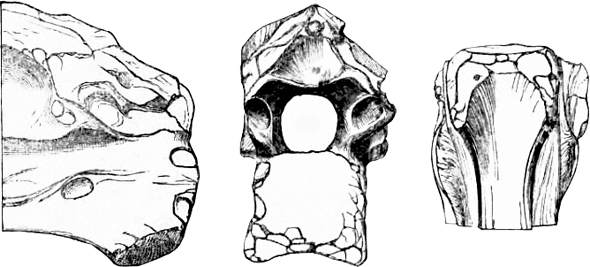
holotype (NHMUK PV R181, previously BMNH R181) is a partial neck vertebra.
Estimations
Timeline:
Era: Mesozoic
Epoch: Early Cretaceous
Stage: Barremian
Age range: 129-125 mya
Stats:
Est. max. length: ?
Est. max. hip height: ?
Est. max. weight: ?
Diet: Herbivore
References
• Seeley HG (1882) "On
Thecospondylus Horneri, a new dinosaur from the Hastings Sand, indicated by the sacrum and the neural canal of the sacral region".
Quarterly Journal of the Geological Society of London, 44: 79-86.
• Seeley HG (1888) "
On Thecospondylus daviesi (Seeley), with some remarks on the classification of the Dinosauria".
Quarterly Journal of the Geological Society of London, 44: 79-86.
• Nopcsa F (1901) "
Synopsis und Abstammung der Dinosaurier".
Földtany Közlöny, 30(1901): 247-279.
• Huene Fv (1923) "
Carnivorous Saurischia in Europe since the Triassic".
Bulletin of the Geological Society of America, 34: 449-458.
• Huene Fv (1926) "
The carnivorous Saurischia in the Jura and Cretaceous formations, principally in Europe".
Revista del Museo de La Plata, 29: 35-167.
• Blows WT (1983) "William Fox (1813—1881), a neglected dinosaur
collector of the Isle of Wight".
Archives of Natural History, 11(2): 299-313.
• Naish D, Hutt S and Martill DM (2001) "Saurichian dinosaurs 2: theropods". Page 296-300 in Martill and Naish (eds.) "
Dinosaurs of the Isle of Wight".
The Palaeontological Association.
• Kirkland JI, Zanno LE, DeBlieux DD, Smith DK, and Sampson SD (2004) "A new, basal-most therizinosauroid (Theropoda: Maniraptora) from Utah demonstrates a Pan-Laurasian distribution for Early Cretaceous therizinosauroids".
Journal of Vertebrate Paleontology, 24(3): 78A.
• Weishampel DB, Barrett PM, Coria RA, Le Loeuff J, Xu X, Zhao X, Sahni A, Gomani EMP and Noto CR (2004) "Dinosaur distribution". Page 556-563 in Weishampel, Dodson and Osmólska (eds.) "
The Dinosauria: Second Edition".
• Naish D and Martill DM (2007) "Dinosaurs of Great Britain and the role of the Geological Society of London in
their discovery".
Journal of the Geological Society, 164: 493-510.
DOI: 10.1144/0016-76492006-032.
• Naish D (2011) "Theropod dinosaurs". Page 530-532 in Batten (ed.) "
English wealden fossils. Field guides to fossils 14".
London: Palaeontological Association.
• Allain R, Vullo R, Le Loeuff J and Tournepiche J-F
(2014) "European ornithomimosaurs (Dinosauria, Theropoda): an undetected record".
Geologica Acta, 12(17): 127-135. DOI: 10.1344/105.000002083.
Time stands still for no man, and research is ongoing. If you spot an error, or want to expand, edit or add a dinosaur, please use
this form. Go
here to contribute to our FAQ.
All dinos are GM free, and no herbivores were eaten during site construction!
To cite this page:
Atkinson, L.
"
THECOCOELURUS :: from DinoChecker's dinosaur archive".
‹
http://www.dinochecker.com/dinosaurs/THECOCOELURUS›. Web access: 23rd Oct 2026.