





Pronunciation: PLAT-ee-o-SOR-us
Meaning: Broad lizard
Author/s: von Meyer (1837)
Synonyms: See below
First Discovery: Heroldsberg, Germany
Acta Ordinal: #5
Plateosaurus trossingensis
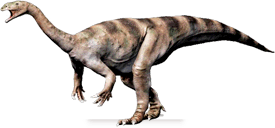
Plateosaurus stands as one of the most intensively studied dinosaurs of the Late Triassic, not because it was rare, but because it was astonishingly abundant. Across the mud?traps of Trossingen, Halberstadt, and Frick, dozens of individuals died in similar circumstances, leaving behind a population?level record unmatched among early dinosaurs. These skeletons reveal a tall, bipedal herbivore with a long neck, grasping hands, and remarkable developmental plasticity—some adults remained small and lightly built, while others grew into heavy, barrel?bodied forms exceeding four tonnes. Its anatomy, ecology, and growth patterns have made Plateosaurus a cornerstone for understanding the rise of sauropodomorphs at the dawn of the age of dinosaurs.
Yet for more than a century, the name Plateosaurus was anchored to a weak foundation. When Hermann von Meyer established Plateosaurus engelhardti in 1837, he did so from fragmentary, undiagnostic scraps — material that was in no fit state to reliably carry a genus. Meanwhile, the beautifully preserved skeletons from Trossingen became the real anatomical standard: the fossils researchers measured, illustrated, and compared in every major study. This mismatch between name and practice persisted until 2019, when the International Commission on Zoological Nomenclature intervened. By designating Plateosaurus trossingensis — a complete, diagnostic Trossingen skeleton — as the neotype, the ICZN formally aligned the name Plateosaurus with the fossils that have long defined it.
Yet for more than a century, the name Plateosaurus was anchored to a weak foundation. When Hermann von Meyer established Plateosaurus engelhardti in 1837, he did so from fragmentary, undiagnostic scraps — material that was in no fit state to reliably carry a genus. Meanwhile, the beautifully preserved skeletons from Trossingen became the real anatomical standard: the fossils researchers measured, illustrated, and compared in every major study. This mismatch between name and practice persisted until 2019, when the International Commission on Zoological Nomenclature intervened. By designating Plateosaurus trossingensis — a complete, diagnostic Trossingen skeleton — as the neotype, the ICZN formally aligned the name Plateosaurus with the fossils that have long defined it.
Etymology
The name Plateosaurus is shrouded in mystery because the original author didn't provide a meaning for what he had in mind. It has been variously decribed as stemming from the Greek "Plata" (flat), "Platy" (paddle), and "plateia" (broadway), with some sources going so far as suggesting they all allude to its broad teeth... which were unknown at the time it was named! Plateosaurus is probably derived from the Greek "platos" (breadth, width, bulk) and the Greek "sauros" (lizard), in reference to the size of its original remains. The species epithet, trossingensis, means "from Trossingen" in Latin. The initial epithet, engelhardti, was named to honour discoverer Johann Friedrich Engelhardt (see discovery). ZooBank registry: urn:lsid:zoobank.org:act:BBCFE37D-5681-45D5-BF27-5342C6DE916E.
Synonyms
Dimodosaurus (Pidancet and Chopard, 1862)
Gresslyosaurus? (Rütimeyer, 1856)
Pachysaurops (von Huene, 1961)
Pachysaurus (von Huene, 1907/1908)
Pachysauriscus (Kuhn, 1959)
Sellosaurus? (von Huene, 1907/1908)
Platysaurus (Agassiz, 1846)
Discovery
The first fossils of Plateosaurus were discovered in a Trossingen Formation clay pit about 2 km South of Heroldsberg, Feuerletten, NE Nuremberg, Bavaria, Germany, by chemistry teacher Dr. Johann Friedrich Philipp Engelhardt in the summer of 1834. Although not assigned as holotype, a set of hip vertebrae (UEN 552) that von Meyer referred to explicitly when discussing the distinctiveness of Plateosaurus in his initial description were nominated as neotype by Markus Moser in 2003.
Since then, Galton petitioned the ICZN to install an almost complete skull and skeleton (SMNS 13200), which has a tumultuous history itself, as replacement neotype because he considers all Plateosaurus engelhardti remains to be either non-diagnostic or "unidentifiable". Although long thought of as the unofficial Plateosaurus "type", that specimen belongs to an altogether different species — Plateosaurus trossingensis (Fraas, 1913) — which was itself considered a nomen nudum by Friedrich von Huene. On top of that, Huene changed the epithet to fraasianus for its official description in 1932 due to concerns over a possible confusion with Teratosaurus trossingensis, which was unnecessary.
Given that a holotype of one valid species cannot act as neotype of another, Galton pushed to have SMNS 13200 installed as the new Plateosaurus name-bearer entirely. Some paleontologists were far from impressed by that proposed course of action, but, nevertheless, Galton was granted his wish in 2019.
Pathology
In 2025, Dupuis et al. described NMZ 1000001, a nearly complete Plateosaurus trossingensis skeleton found in the Klettgau Formation at Gruhalde Quarry in Frick, Switzerland, in 2018, that was nicknamed "Frosch" ("frog") due to the frog-kick posture in which the belly-down skeleton was found.
The specimen showed evidence of pathology (injury or disease), in this case, severe osteomyelitis: a bone infection affecting its right shoulder blade and upper arm, with the tell-tale signs being roughened surface textures, possible fusion of nearby bones, and significant changes inside the bone structure of the infected areas.
The severity of its infection indicates that it likely lived with the condition for an extended period before it finally croaked at the grand old age of twenty-five.
An estimated body length of 7.8 meters makes it one of the largest known Plateosaurus specimens from Frick.
Preparators
Ursina Bachmann of the Sauriermuseum Frick, Schulstrasse, Switzerland and Ben Pabst of the Sauriermuseum Aathal, Zürichstrasse, Switzerland. ("Frosch")


