









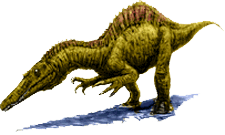
Pronunciation: sie-AM-o-SOR-us
Meaning: Siamese lizard
Author/s: Buffetaut and Ingavat (1986)
Synonyms: None known
First Discovery: Khon Kaen, Thailand
Acta Ordinal: #331
Siamosaurus suteethorni
In 1998, Eric Buffetaut named Siamosaurus on the strength of an "unusual" and "theropod-like" tooth from the Sao Khua Formation of Khon Kaen, Northeastern Thailand, that was long thought to be the property of a giant Ichthyosaur ("fish lizard"), and in doing so raised the first spinosaurid dinosaur known from Asia. More isolated teeth have since been assigned to it based on their similar conical design, but despite a complete lack of any other body part, a hypothetical Siamosaurus made it onto its own Thai postage stamp in 1997.
Funnily enough, excavations begain in 2005 on a large theropod skeleton, including high-spined vertebrae and pelvic bones in the much younger Khok Kruat Formation of Khon Kaen that clearly belongs to a spinosaurid. Siamosaurus-like teeth were discovered with it, but they were alongside rather than attached, so Siamosaurus can't lay claim to any of the skeleton, as it's just as likely that the teeth were left there by a scavenger of the carcass.
Isolated Siamosaurus-like teeth have also been found in the Khok Kruat Formation at Khok Pa Suam (Ubon Ratchathani Province), and teeth from the Napai Formation at Fusui County, Guangxi, China, that were initially referred to the pliosaur Sinopliosaurus fusuiensis by Hou in 1975, actually belong to a Siamosaurus-like spinosaurid, perhaps Siamosaurus itself. Fortunately, just as we were becoming so utterly bored with typing the word "teeth", someone came along and did something really interesting with them.
In 2010, Romain Amiot and colleagues compared the isotopic compositions in the teeth of the spinosaurids Siamosaurus, Baryonyx, Irritator and Spinosaurus with those of contemporaneous theropods, turtles and crocodilians, and found that their oxygen isotope ratios were closer to those found in the latter. The results suggest that spinosaurids, like modern crocodilians and hippopotamuses, spent much of their daily lives in water and avoided direct competition with other large theropods by adopting semi-aquatic habits and piscivory. The oxygen isotope ratios in the teeth of Siamosaurus were closest to the study's water-dwelling critters, but the teeth with the closest ratio to land-dwelling theropods belonged to Spinosaurus, which was recently recovered as fully aquatic. Go figure.
Funnily enough, excavations begain in 2005 on a large theropod skeleton, including high-spined vertebrae and pelvic bones in the much younger Khok Kruat Formation of Khon Kaen that clearly belongs to a spinosaurid. Siamosaurus-like teeth were discovered with it, but they were alongside rather than attached, so Siamosaurus can't lay claim to any of the skeleton, as it's just as likely that the teeth were left there by a scavenger of the carcass.
Isolated Siamosaurus-like teeth have also been found in the Khok Kruat Formation at Khok Pa Suam (Ubon Ratchathani Province), and teeth from the Napai Formation at Fusui County, Guangxi, China, that were initially referred to the pliosaur Sinopliosaurus fusuiensis by Hou in 1975, actually belong to a Siamosaurus-like spinosaurid, perhaps Siamosaurus itself. Fortunately, just as we were becoming so utterly bored with typing the word "teeth", someone came along and did something really interesting with them.
In 2010, Romain Amiot and colleagues compared the isotopic compositions in the teeth of the spinosaurids Siamosaurus, Baryonyx, Irritator and Spinosaurus with those of contemporaneous theropods, turtles and crocodilians, and found that their oxygen isotope ratios were closer to those found in the latter. The results suggest that spinosaurids, like modern crocodilians and hippopotamuses, spent much of their daily lives in water and avoided direct competition with other large theropods by adopting semi-aquatic habits and piscivory. The oxygen isotope ratios in the teeth of Siamosaurus were closest to the study's water-dwelling critters, but the teeth with the closest ratio to land-dwelling theropods belonged to Spinosaurus, which was recently recovered as fully aquatic. Go figure.
(Suteethorn's Thai Lizard)Etymology
Siamosaurus is derived from "Siam" (an old name for Thailand) and the Greek "sauros" (lizard). The species epithet, suteethorni, honors Thai paleontologist Varavudh Suteethorn.
Discovery
The first remains of Siamosaurus were discovered at "Phu Wiang 1A, Phu Pratu Teema" in the Sao Khua Formation (Khorat Group), Changwat Khon Kaen, Thailand, in 1986.
The holotype (TF 2043a) is a single tooth.
Envoironment
Siamosaurus lived in a well-vegetated area with slow-moving rivers, meandering channels and extensive flood plains. This fits with the results of a 2010 study of oxygen isotopes in dinosaur fossils by Romain Amiot and colleagues, who found that spinosaurid bone structure was closer to that seen in turtles and crocodiles than other theropod dinosaurs, suggesting they spent much of their lives in water.


