(the animal kingdom)
Tetropoda
(critters adapted to life on land)
Amniota
(critters that lay eggs)
Diapsida
(snakes, crocs, lizards and birds)
Archosauromorpha
(closer to Archosauria than to lizards and snakes)
Archosauria
(pterosaurs, birds and crocs, and their ancestors)
Avemetatarsalia
(closer to birds than to crocs)
Dinosauriformes
(dinosaurs and closest non-dinosaur relatives)
Dinosauria
(the dinosaurs, including birds)
Pronunciation: DIE-no-SOR-ree-uh
Author: Sir Richard Owen
Year: 1842
Meaning: Fearfully Great Lizards
Locomotion: Bi and Quadrupedal (2 or 4 legs)
Synonyms:
Eudinosauria (Novas, 1992)
Deinosauria (Watson, 1957)
Dinosauri (Bronn, 1851)
Eudinosauria (Novas, 1992)
Deinosauria (Watson, 1957)
Dinosauri (Bronn, 1851)
[Sereno, 2005]Definition
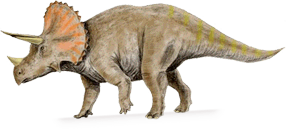
The least inclusive clade containing Triceratops horridus and Passer domesticus (House Sparrow).
About
Dinosauria rises in the long shadow of catastrophe — the slow ecological recovery that followed the end-Permian mass extinction, when life clawed its way back from the brink and the Triassic world rebuilt itself piece by piece. From within the avian-line archosaurs came their ancestors: small, agile dinosauromorphs like Marasuchus, already experimenting with upright limbs, efficient strides, and the elevated metabolisms that would one day define their descendants.
Around 232 million years ago, in the floodplains of the Ischigualasto and Santa Maria basins, the first true dinosaurs stepped into view. They were small, lightly built newcomers moving through landscapes still dominated by immense pseudosuchian predators. Their early innovations were subtle but decisive: an open hip socket receiving an inward-facing thigh balljoint; bringing their legs beneath the body rather than sprawling to the sides; a posture that steadied the torso, improved breathing, and allowed sustained, economical movement.
Filamentous proto-feathers flickered into existence in several lineages — simple threads of keratin hinting at insulation, display, or sensory function long before true feathers evolved. The fossil record of this dawn is fragmentary, but what survives reveals a clade feeling its way into being through experimentation and opportunism, testing forms that would later define their rise.
Once established, dinosaurs developed a recognisable character built around efficiency, adaptability, and a willingness to explore ecological space. Early in their history, Dinosauria split into its two great branches — Saurischia and Ornithischia — each carrying forward a different interpretation of the dinosaurian blueprint. From this foundation, the clade radiated into an astonishing array of body plans: long-necked browsers, armour-plated grazers, feathered hunters, dome-headed omnivores, scythe-clawed herbivores, croc-snouted fish eaters, gliders, climbers, burrowers, and other evolutionary oddballs pushing the limits of their design. Despite this breadth, they shared a unifying constraint: all dinosaurs laid eggs. This single reproductive strategy shaped their nesting behaviours, growth rates, and early life histories across the entire clade. Evolutionary tensions — speed versus strength, generalism versus specialisation, lightness versus protection — drove their diversification, producing a spectrum of solutions rather than a single dominant form.
Dinosaurs reached their zenith in the Jurassic and Cretaceous, becoming the structural backbone of terrestrial ecosystems on every continent. Sauropods reshaped landscapes through relentless browsing; hadrosaurs and ceratopsians gathered in vast herds that ruled the floodplains; and theropods, from swift mid-sized hunters to towering apex predators, orchestrated the dynamics of predation. They lived alongside early mammals, pterosaurs, and crocodilians in ecosystems defined by competition, coexistence, and continual adaptation. Their decline was sudden. The end-Cretaceous asteroid impact — amplified by volcanic upheaval and climatic stress — shattered the ecological scaffolding that had supported them for over 160 million years. Yet their story did not end. A single surviving branch of small, feathered, warm-blooded dinosaurs — already deep into the avialan experiment — endured the darkness and radiated into the birds of the modern world. Today, Dinosauria’s legacy is twofold: the vanished giants that shaped Mesozoic landscapes, and the living descendants that fill our skies, forests, and shorelines. No other vertebrate clade bridges deep time and the modern world so visibly.
Etymology
Dinosauria is derived from the Greek words "deinos" and "sauros". Owen translated the "deinos" of Dinosauria as "fearfully great", to evoke their size and majesty (in contrast to the "deinos" of Deinonychus, which Ostrom translated as "terrible", to evoke its wicked claws). The "sauros" part is a misnomer, because it means "lizard" and Dinosaurs are actually reptiles. But you can't be changing classical Greek on a whim, so all the tantrums in the world won't change the fact that "sauros" does not mean "reptile". Dinosaurs are the "Fearfully Great Lizards".
Relationships
References
• Owen R (1842) "Report on British Fossil Reptiles" Part II". Report of the Eleventh Meeting of the British Association for the Advancement of Science. Held at Plymouth in July 1841. London: John Murray. pp. 60–204.
• Currie PJ and Padian K (1997) "Encyclopedia of Dinosaurs".
• Benton MJ (2004) "Origin and relationships of Dinosauria". Page 7-19 in Weishampel, Dodson and Osmólska (eds.) "The Dinosauria: Second Edition".
• Brett-Surman MK, Holtz Jr TR and Farlow JO (2012) "The Complete Dinosaur: Second Edition".
• Brusatte S (2019) "The Rise and Fall of the Dinosaurs: A New History of a Lost World".
• Hearn L and Williams AC de C 2019) "Pain in dinosaurs: what is the evidence?". Philosophical Transactions of the Royal Society B, 374: 20190370. DOI: 10.1098/rstb.2019.0370.
• Benton MJ (2020) "Dinosaurs Rediscovered: The Scientific Revolution in Paleontology".
• Bonsor JA, Barrett PM, Raven TJ and Cooper N (2020) "Dinosaur diversification rates were not in decline prior to the K-Pg boundary". Royal Socirty open science, 7: 201195. DOI: 10.1098/rsos.201195
• Tahoun M, Engeser M, Namasivayam V, Sander PM and Müller CE (2022) "Chemistry and Analysis of Organic Compounds in Dinosaurs".
Biology, 11(5): 670. DOI: 10.3390/biology11050670
• Hone D (2022) "The Future of Dinosaurs: What We Don't Know, What We Can, and What We'll Never Know".
• Romilio A and Shao C (2023)
Analysing trackway-based speed calculations to infer dinosaur locomotive capabilities and behaviours". Historical Biology. DOI: 10.1080/08912963.2023.2251127.
• Dempsey M, Cross SRR, Maidment SCR, Hutchinson JR and Bates KT (2025) "New perspectives on body size and shape evolution in dinosaurs".
Biological Review, 100(5): 1829-1860.
DOI: 10.1111/brv.70026.
• Takasaki R, Kobayashi Y, Fiorillo AR, Chinzorig T and Funston GF (2026) "Gastrolith shape as an indicator of digestive function and its implications for dinosaurian digestive strategies". Paleobiology: 1-12. DOI: 10.1017/pab.2026.10112M.