









Pronunciation: bee-chah-RAH-koh-SOR-us
Meaning: Big Lizard
Author/s: Reutter et al. (2026)
Synonyms: None known
First Discovery: Chubut Province, Argentina
Acta Ordinal: #1242
Bicharracosaurus dionidei
Bicharracosaurus dionidei is a sauropod dinosaur from the Late Jurassic Cañadón Calcáreo Formation of Chubut Province, Argentina, first recognized thanks to bones spotted by Dionide Mesa, a local farmer, in 2001. The holotype preserves a long run of vertebrae and pelvic fragments that outline a mid-sized, long-necked herbivore roughly 15–20 meters long. Its name blends bicharraco—a casual Spanish term for a big, impressive creature—with a tribute to Mesa himself.
What really defines Bicharracosaurus is the character of its backbone. Even without a complete skeleton, the preserved vertebrae show a distinctive "signature": unusually shaped air-filled cavities in the tail bones, a small ridge on the back of the neck vertebrae, and sacral joints with a broad, shallow outline. You don’t need the technical terms to appreciate the point—its bones have a set of telltale features that let palaeontologists place it confidently within Macronaria, and repeated analyses suggest it may sit close to the brachiosaurids.
If that interpretation holds, Bicharracosaurus marks an important milestone: the first Jurassic brachiosaurid known from South America, filling a long-standing gap in Gondwanan sauropod history. Its mix of traits—some echoing African giants like Giraffatitan, others leaning toward the architecture seen in diplodocids—suggests that early macronarians were experimenting with more varied body plans than once appreciated.
What really defines Bicharracosaurus is the character of its backbone. Even without a complete skeleton, the preserved vertebrae show a distinctive "signature": unusually shaped air-filled cavities in the tail bones, a small ridge on the back of the neck vertebrae, and sacral joints with a broad, shallow outline. You don’t need the technical terms to appreciate the point—its bones have a set of telltale features that let palaeontologists place it confidently within Macronaria, and repeated analyses suggest it may sit close to the brachiosaurids.
If that interpretation holds, Bicharracosaurus marks an important milestone: the first Jurassic brachiosaurid known from South America, filling a long-standing gap in Gondwanan sauropod history. Its mix of traits—some echoing African giants like Giraffatitan, others leaning toward the architecture seen in diplodocids—suggests that early macronarians were experimenting with more varied body plans than once appreciated.
(Mesa's Big Lizard)Etymology
Bicharracosaurus is derived from the informal Spanish "bicharraco" (big animal), a term used by discoverer Dionide Mesa to refer to the big size of the fossils when he reported them to Oliver Rauhut in March 2001, and the Greek "sauros" (lizard).The species epithet, dionidei, honours Dionide Mesa, who found this specimen and other dinosaur bones on his farm. ZooBank registry: urn:lsid:zoobank.org:act:71DC4A62-78B6-456B-B528-33528A4D6673.
Discovery
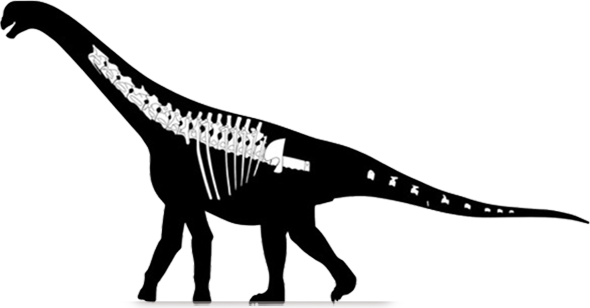
The remains of Bicharracosaurus were discovered at the Dionide 3 locality in the Cañadón Calcáreo Formation, 24 km north of Cerro Cóndor and east of the Chubut River, Chubut Province, Argentina, by local farmer Dionide Mesa, in 2001. The holotype (MPEF-PV 1730) is a partially articulated specimen, including seven neck vertebrae (/1-7), four disarticulated and fragmentary neck ribs (/23-26), ten back vertebrae (/7-12) and disarticulated ribs (/29-38), five articulated hip vertebrae fused to part of the hip (/13), nine tail vertebrae (/14-22), one fragmentary chevron (/28) and several undiagnostic pelvic and rib elements. Excavation began in 2002, most of the specimen was removed from the field in 2011, and additional neck vertebrae were removed in 2018.
Referred material includes three partial back vertebrae (MPEF-PV 1324), also discovered on the land of Dionide Mesa, approximately two kilometres southeast of the holotype site, that were initially identified as the first diplodocid fossils known from the Late Jurassic of South America in 2015.
Preparators
Mariano Caffa and Leandro Canessa of the Museo Paleontológico Egidio Feruglio (MPEF), Trelew, Argentina.


