




Pronunciation: NOT-o-cuh-LOSS-us
Meaning: Southern giant
Author/s: González Riga, et al. (2016)
Synonyms: None known
First Discovery: Mendoza Province, Argentina
Acta Ordinal: #935
Notocolossus gonzalezparejasi
The biggest problem for "the biggest ever sauropod" is that whatever "it" is, is challenged on a regular basis, especially by Argentinian titanosaurs, and in no time at all, they are challenged themselves. Unfortunately, these pretenders are often represented by just the odd bone or three, so although it's nice to think that a humongous toe, tooth or tibia belongs to something as big if not bigger than the current title holder, it's generally just pie in the sky.
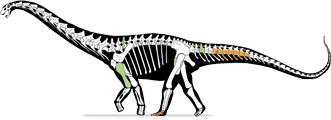
Notocolossus from Mendoza Province—coined a mere fortnight after the latest but as yet un-named "biggest ever" sauropod was found, and 15 months after the "mighty" Dreadnoughtus hit the headlines and was promptly downsized—is the latest contender. But typically, it was named on the strength of just a couple of vertebrae, a piece of hip and a close-to-six-foot-long uber-robust upper arm bone. However, by implementing proportionate upscaling based on its better-represented relatives, palaeontologists reckon the "southern giant" was a critter some 28 meters long and around 50 tons in weight. Is it the biggest ever sauropod? Oh, hell no. Not even close. But it is better represented than many, thanks to a second specimen found around 400 meters from the first, which, while smaller and equally meagre, includes parts that are almost as rare as pigeon teeth.
As the name suggests, titanosaurs from Argentina (apart from the dicraeosaurid titanosaurs) are giants, even the smaller ones. But palaeontologists knew little of the stance and locomotion of the exceptionally massive variety because foot bone discoveries have been few and far between, and whole feet even more so. Notocolossus, then, is a darling, as it's a truly huge titanosaur, judging by its colossal humerus. But it also owns one of the few complete titanosaur feet discovered thus far.
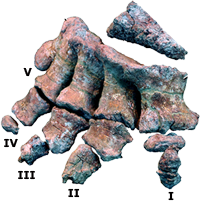 Compared to non-titanosaurian neosauropods with their namby-pamby metatarsals and long slender toes, the feet of Notocolossus are strikingly compact and seemingly adapted for bearing extraordinary weight. Five metatarsals (the bones between the ankle and toes) are short, thick and remarkably robust, and all approximately the same length, which appears to be a design for even weight distribution. Its toes are also very robust and short, not least because they boast just two phalanges (toe bones) on digits one to four, and digit five is shorter still because there isn't one. The unguals (last bone of the toes) of digits one, two and three may have been clawed, but the tips are gnarly and irregular-shaped, which suggests a possible infection during life.
Notocolossus from Mendoza Province—coined a mere fortnight after the latest but as yet un-named "biggest ever" sauropod was found, and 15 months after the "mighty" Dreadnoughtus hit the headlines and was promptly downsized—is the latest contender. But typically, it was named on the strength of just a couple of vertebrae, a piece of hip and a close-to-six-foot-long uber-robust upper arm bone. However, by implementing proportionate upscaling based on its better-represented relatives, palaeontologists reckon the "southern giant" was a critter some 28 meters long and around 50 tons in weight. Is it the biggest ever sauropod? Oh, hell no. Not even close. But it is better represented than many, thanks to a second specimen found around 400 meters from the first, which, while smaller and equally meagre, includes parts that are almost as rare as pigeon teeth.
As the name suggests, titanosaurs from Argentina (apart from the dicraeosaurid titanosaurs) are giants, even the smaller ones. But palaeontologists knew little of the stance and locomotion of the exceptionally massive variety because foot bone discoveries have been few and far between, and whole feet even more so. Notocolossus, then, is a darling, as it's a truly huge titanosaur, judging by its colossal humerus. But it also owns one of the few complete titanosaur feet discovered thus far.
Compared to non-titanosaurian neosauropods with their namby-pamby metatarsals and long slender toes, the feet of Notocolossus are strikingly compact and seemingly adapted for bearing extraordinary weight. Five metatarsals (the bones between the ankle and toes) are short, thick and remarkably robust, and all approximately the same length, which appears to be a design for even weight distribution. Its toes are also very robust and short, not least because they boast just two phalanges (toe bones) on digits one to four, and digit five is shorter still because there isn't one. The unguals (last bone of the toes) of digits one, two and three may have been clawed, but the tips are gnarly and irregular-shaped, which suggests a possible infection during life.
(Parejas' Southern Colossus)Etymology
Notocolossus is derived from the Greek "notos" (southern) and the Latin "colossus", in reference to its discovery on Gondwana (the southern counterpart of the Northern Laurasia: two landmasses that separated from Pangea during the mid-Mesozoic period) and to its gigantic size.The species epithet, gonzalezparejasi, honours Dr. Jorge González Parejas, who has collaborated and provided legal guidance on the research, protection, and preservation of dinosaur fossils from Mendoza Province for nearly two decades. In so doing, he has advised researchers on the creation of a natural park that serves to protect dinosaur footprints in Mendoza. ZooBank registry: urn:lsid:zoobank.org:act:34979D66-9C7E-469C-B072-AB9FB8F6B705.
Discovery
The remains of Notocolossus were discovered in the Plottier
Formation (Neuquén Group) at Cerro Guillermo, Mendoza Province, Argentina, by Bernardo J. González Riga.The holotype (UNCUYO-LD 301) is the partial skeleton of a very large individual consisting of one back vertebra, one tail vertebra, the end of the left pubis, and a 1.76m right humerus which is longer than that of any other known titanosaur, though most "bigger" titanosaurs are missing this bone.
A second, somewhat smaller specimen (UNCUYO-LD 302, from a 5m x 5m area some 403m from the holotype but at the same stratigraphic level) was also assigned to Notocolossus, and includes a series of 7 partial tail vertebrae with haemal arches, and a complete right ankle and foot.


